Skip to content


Alarplasty and Rhinoplasty Comparison: Which Procedure Fits Your Nose Shape
Selecting between alarplasty and rhinoplasty depends on whether your lower nose appears wide due to flared soft tissue or a low, unsupported structural bridge. Alarplasty isolates and reshapes the nostril wings at the base, whereas rhinoplasty elevates, straightens, or rebuilds the internal framework of the bridge and tip.
In Ho Chi Minh City, Vietnam, surgical options across these categories fall into three main paths in 2026:
- Standalone Alarplasty (Base Narrowing): $190 to $570 (5 to 15 million VND)
- Standalone Rhinoplasty (Framework Reshaping): $540 to $8,440 (14 to 220 million VND)
- Combined Alarplasty and Rhinoplasty: The combined cost of framework and base work, healing on the rhinoplasty recovery timeline.
Below is an overview of how these procedures differ, self-assessment guidelines, procedure highlights, combined surgical benefits, and travel planning considerations.

Technical Differences Between Alarplasty and Rhinoplasty
Alar base reduction works exclusively on soft tissue at the nostril junction, whereas structural nose surgery modifies the internal cartilage and bone matrix.
| Technical Aspect | Alarplasty | Rhinoplasty |
| Primary Target Zone | Nostril wings, nostril sill, and base floor | Bridge height, nasal tip, septum, and structural support |
| Anatomical Changes | Nostril width, flare curvature, opening size | Profile line, tip projection, bridge straightness |
| Incision Placement | Along the outer alar crease or hidden in the sill | Concealed inside nostrils (closed) or across columella (open) |
| Anesthesia Protocol | Local anesthesia | Local anesthesia with sedation or general anesthesia |
| Recovery | 3 to 5 days; stitches removed on days 5 to 7 | 1 to 2 weeks; external splint removed on days 5 to 7 |
| Scar & Swelling Settlement | Incisions fade within 1 month | 90% swelling resolves in 3 months; final shape at 1 year |
| Cost Range in HCMC (2026) | $190- 570 (5–15 million VND) | $540-8,440 (14–220 million VND) |
Neither procedure replaces the other. Narrowing nostril tissue will not elevate a low bridge, and adding bridge height cannot reduce thick, fleshy alar wings.
Which Technique Suits Your Nose Shape?
Determining whether standalone alarplasty, formal rhinoplasty, or a combined procedure fits your nose shape depends on comparing your nasal base width directly against your intercanthal distance (the space between the inner corners of your eyes), alongside evaluating your bridge height and tip projection.
- Nasal Base Width Exceeds Intercanthal Distance (Bridge & Tip Proportions Are Balanced): Standalone alarplasty is the primary surgical recommendation. Because your bridge height and tip definition are already aesthetically harmonized with your face, selectively excising or folding flared nostril tissue narrows your base without altering your overall profile.
- Nasal Base Width Equals Intercanthal Distance (Bridge Is Low or Tip Is Round/Bulbous): Standalone rhinoplasty is indicated. When the nasal bridge lacks vertical height, it creates an optical illusion that makes a normally proportioned base appear wide. Elevating the bridge with an implant or structural cartilage draws visual focus upward and naturally narrows the appearance of the nostrils without cutting base tissue.
- Nasal Base Width Exceeds Intercanthal Distance AND the Bridge Is Visibly Low: A combined procedure (rhinoplasty plus alarplasty) is required. Elevating the bridge and sculpting the tip is performed first, which subtly stretches surrounding soft tissue. Your surgeon then measures the remaining flare and performs a conservative alar reduction to achieve complete structural harmony.
- Nostril Flaring Occurs Primarily When Smiling (Dynamic Flaring): Alarplasty (specifically alar rolling or sill excision) controls how much your nostrils spread when you laugh or smile, keeping your nose shape stable and natural during facial expressions.
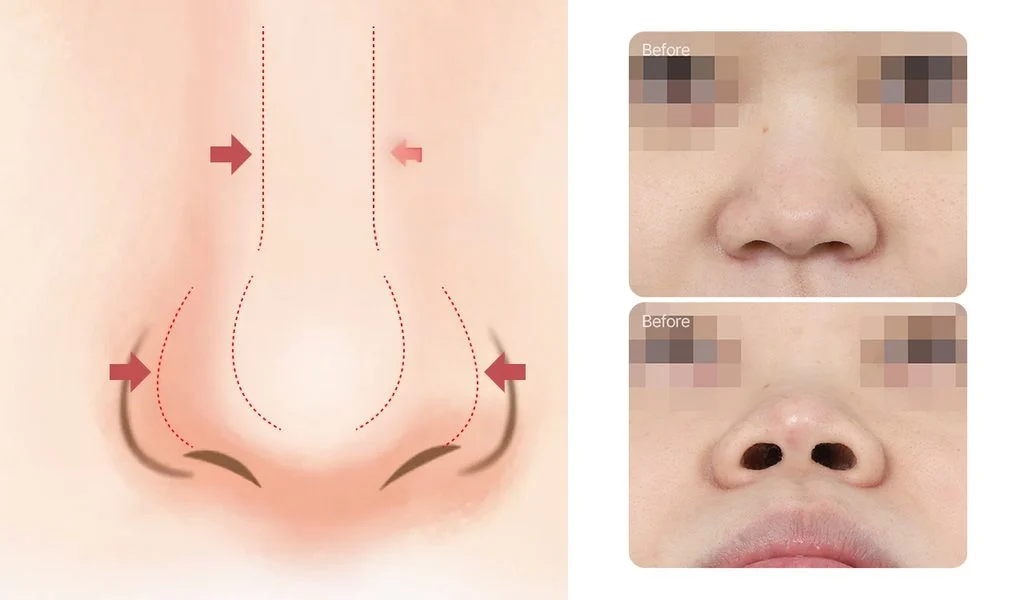
Who Should Choose Alar Reduction?
Alar reduction (alarplasty) suits individuals whose nasal bridge height and tip definition are already aesthetically harmonized, but whose nostril wings appear naturally wide, thick, or flared.
How the Procedure Works for Your Nostrils
Surgical base reduction excises or folds a small strip of soft tissue near the natural crease where the nostril meets the cheek or nostril floor. Surgeons select between two primary techniques depending on tissue thickness:
- Alar Excision: Removes a crescent of tissue along the outer crease, making it ideal for individuals with thick, heavy nostril wings.
- Alar Rolling: Folds the nostril base inward using internal tension sutures without cutting outer skin, making it ideal for thin wings with mild flaring.
Key Advantages of Alar Reduction
- Efficient Outpatient Procedure: Completed under local anesthesia in under 45 minutes, allowing you to resume normal daily activities within 3 to 5 days.
- Concealed Incision Lines: Surgical cuts follow natural anatomical creases, fading steadily over 3 to 4 weeks.
- Secondary Refinement Capability: Can be performed safely as a touch-up procedure after a prior bridge lift has fully healed.
Clinical Limitations to Consider
- Does Not Alter Framework: Bridge height and tip projection remain completely unchanged.
- Non-Reversible Tissue Excision: Because excised tissue cannot be replaced, conservative initial tissue removal is essential to avoid over-reduction.
Who Should Choose Plastic Surgery Rhinoplasty?
Plastic surgery rhinoplasty suits individuals whose primary goal is elevating a flat profile, refining a rounded tip, straightening a crooked septum, or restructuring a nose that lacks vertical height and support.
Technical Options and Investment Overview
Framework surgery modifies or rebuilds the internal cartilage and bone matrix to adjust overall nasal straightness, bridge height, and tip projection:
| Surgical Technique | Estimated Cost in HCMC (2026) | Initial Healing Window |
| Simple Bridge Implant | $540-860 (14–22.4M VND) | Stitches removed on days 5 to 7 |
| Implant + Cartilage Tip Shield | $770-1,050 (20–27.5M VND) | Stitches/splint removed on days 7 to 10 |
| Structural Rhinoplasty | $1,150-2,950 (30–77M VND) | Splint removed on days 7 to 10; settling in 10–15 days |
| Autologous Rib Cartilage Surgery | $3,070-8,440 (80–220M VND) | Splint removed on days 7 to 10; recovery in 15–20 days |
Key Advantages of Rhinoplasty
- Elevates Low Profiles: Biocompatible implants or autologous cartilage grafts add vertical height that soft-tissue work alone cannot achieve.
- Refines Bulbous Tips: Precise cartilage sculpting narrows rounded tip shapes and corrects droopiness.
- Corrects Structural Asymmetry: Structural techniques can straighten deviated septums and repair earlier compromised surgeries.
Clinical Limitations to Consider
- Extended Healing Timeline: Protective splints remain in place for 1 to 2 weeks, with final tissue maturation requiring up to 1 year.
- Untouched Soft Tissue: Heavy, fleshy nostril wings remain broad unless alar base reduction is performed simultaneously.
→ Learn more: Structural rhinoplasty against a standard nose lift
Cost Comparison: Alar Base Reduction vs. Nose Lift
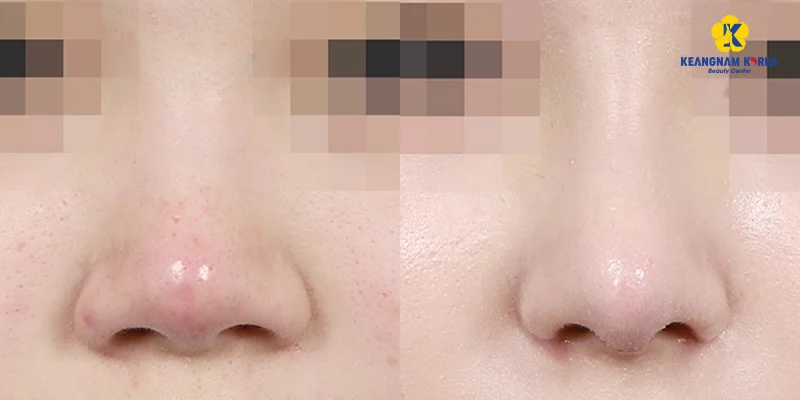
An alarplasty cost ranges from $190 to $570 (5 to 15 million VND) in Ho Chi Minh City in 2026, making it lower in price than any framework surgery. Basic bridge implants start at $540, with costs increasing for structural or autologous rib cartilage techniques.
→ Learn more: Alar base reduction prices in detail
Surgical Planning at Keangnam Korea
Keangnam Korea provides tailored alar and bridge procedures in Ho Chi Minh City, utilizing Face AI Pro digital diagnostic simulation to preview projected profile changes before surgery. Located at 394–396 Cao Thắng, Ho Chi Minh City, Vietnam (Department of Health Operating License: 06303/HCM-GPHĐ), our center adheres to strict safety protocols.
- Objective Diagnostic Analysis: Measures nostril base width against intercanthal distance and evaluates wing thickness by touch before recommending a technique.
- Side-by-Side Digital Previews: Compares standalone alar reduction against combined framework lifting on an interactive 3D display.
- 100% Doctor Continuity: Your examining specialist performs your surgical procedure and oversees your post-operative check-ups.
- Dedicated VIP Support: English-speaking care coordinators assist throughout your consultation, written quote review, and post-flight follow-up.

CLAIM YOUR FREE 3D NOSE ANALYSIS & ITEMIZED QUOTE NOW
Can I have alarplasty after an earlier rhinoplasty?
Yes. A nostril base that remains broad following a prior bridge lift can be narrowed in a secondary procedure under local anesthesia. Wait 3 to 6 months until swelling from the initial rhinoplasty resolves so your surgeon can accurately judge final base proportions.
Which heals faster, alarplasty or rhinoplasty?
Alarplasty heals faster. Stitches are removed on days 5 to 7, with normal daily routines resuming in 3 to 5 days. Rhinoplasty requires a protective splint for 1 to 2 weeks, with final tissue settling taking up to 1 year.
How long should I stay in HCMC for alarplasty and rhinoplasty together?
Plan your travel stay around the rhinoplasty timeline. A combined procedure with a simple bridge implant requires 10 to 14 days in Ho Chi Minh City, while structural or rib cartilage procedures require 14 to 21 days for safe suture removal and pre-flight clearance.
RELATED ARTICLES

Top Korean Rhinoplasty Clinics in Ho Chi Minh City & Latest Price List
A Korean rhinoplasty clinic in Ho Chi Minh City charges about $537 to $859 (14 to 22.4 million VND) for a basic Korean-style nose lift with an artificial implant, and $1,150 to $2,995 (30 to 78.1 million VND) for structural

Is Nose Thread Lift Safe? Results, Risks and Alternatives
A nose thread lift is generally safe when a trained doctor performs it in sterile conditions on an appropriate nose shape, but it still carries surgical risks such as infection, visible thread outlines, and thread migration. Results typically persist for

Mesotherapy for Skin Brightening: Costs, Clinic and Safety Guide
Mesotherapy for skin brightening cost in Ho Chi Minh City ranges from $58 to $192 (1.5 to 5 million VND) per session for basic vitamin C and hyaluronic acid formulas, reaching $460 to $959 (12 to 25 million VND) for

How Much Does Mesotherapy Cost in Vietnam?
Mesotherapy in Vietnam costs about $77 to $575 (2 to 15 million VND) per session in Ho Chi Minh City, depending on your treatment goal and active ingredients. A basic hyaluronic acid session starts lower, at $58 (1.5 million VND).

How to Get Fair Skin for Men? 6 Skin Brightening Treatments for Men in Ho Chi Minh City
How to get fair skin for men? Skin brightening for men focuses on eliminating sun tan, rough texture, and dark spots to reveal your natural skin tone. While daily sun protection and niacinamide serums manage light surface dullness, professional options

Collagen Injection: Benefits, Types, Pain and Price in Ho Chi Minh City
A collagen injection places purified collagen, or a biostimulatory substance that prompts your skin to build its own collagen, into the dermal layer to improve firmness, skin thickness, and fine lines. Collagen injection prices in Ho Chi Minh City vary