Skip to content


Collagen Injections for Face: Benefits, Results & Cost in Ho Chi Minh City
Collagen injections for face deliver a concentrated collagen formulation directly into the dermis, the structural layer 1 to 4 mm beneath the surface that dictates overall skin density and firmness, to reactivate your skin’s natural cellular regeneration cycle. Rather than providing instant volume, visible structural improvements develop progressively between weeks 4 and 8 post-treatment. A price per session runs $20 to $570 in Ho Chi Minh City in 2026, and the gap tracks how many milligrams of collagen the vial holds.
This article explains what the injection does to skin, which of the four collagen sources sold in Vietnam suits which problem, and what each price tier buys. It also covers risks, aftercare, and the cases that should be postponed.

Effects of Collagen Injections on Facial Skin
Collagen injections improve fundamental dermal quality while preserving your natural facial proportions and features. Rather than altering volume or contours, the treatment enhances skin thickness, elasticity, and overall structural resilience through a progressive three-stage cellular process:
- The Scaffold Stage: Micro-droplets of collagen settle into the deep dermis, establishing an immediate extracellular matrix for structural cellular attachment.
- The Signal Stage: Natural enzymatic breakdown breaks down the injected material into bioactive peptides and amino acids, signaling fibroblast cells to initiate localized tissue repair.
- The Replacement Stage: Fibroblasts synthesize new, endogenous collagen fibers, seamlessly taking over as the temporary injected scaffold naturally degrades.
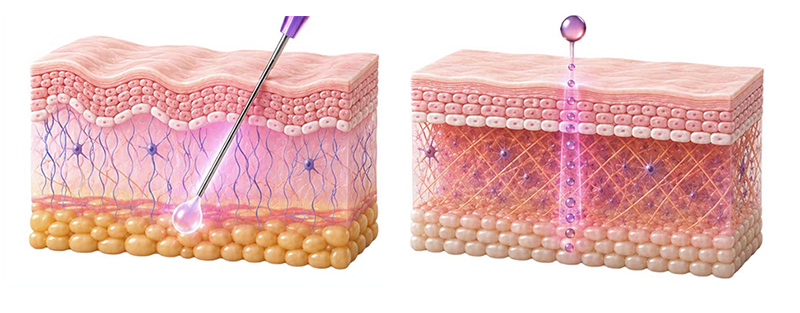
What to Expect: Results and Timeline
Because newly generated collagen is entirely your skin’s own, aesthetic outcomes appear natural, refreshed, and harmonious:
- Visible Dermal Benefits: Softens fine lines from within, increases skin elasticity, and creates a smoother, more light-reflective surface texture.
- Gradual Structural Maturation: Beyond immediate surface hydration, deep structural remodeling and visible skin firming take 4 to 8 weeks to fully develop.
Why Is Collagen Type I Injection Used on Facial Skin?
Type I collagen comprises 80% to 90% of total skin collagen, with types III and V accounting for the remaining fraction. Utilizing a targeted type I collagen injection directly replenishes the primary structural component that degrades first due to natural aging.
Key biological properties supporting its clinical selection include:
- High Biocompatibility: Advanced processing yields a molecular structure approximately 95% identical to human collagen, minimizing tissue reactivity and keeping rejection risks low.
- Primary Component Depletion: Endogenous collagen production declines steadily starting around age 25, with type I experiencing the most significant loss.
- Structural Integrity & Biostability: Type I collagen forms dense, thick fiber bundles that resist rapid degradation, maintaining a stable temporary scaffold long enough for host fibroblasts to synthesize replacement tissue.

Comparing Collagen Sources Sold in Vietnam
Four collagen sources circulate on the Vietnamese market, and the source decides purity, durability, and price more than the clinic name does. Common types include:
- Fish collagen: Small molecules drawn from skin and scales, absorbed quickly. Most sessions sold as fresh collagen infusion at beauty salons run on this material, aimed at hydration and surface brightness.
- Porcine collagen: Structurally closer to human collagen, so reaction rates run lower. It usually arrives as a powder for reconstitution and is used for rebuilding the skin base and treating shallow acne scars.
- Recombinant collagen: Produced by biotechnology rather than extracted from animals, with high purity and consistent quality between batches. It often comes packaged with a humectant in the same syringe for micro-point injection.
- Type I collagen from horse tendon: Drawn from tendon, where pure type I density is highest, then enzyme-treated to strip the protein segment that triggers an immune reaction. A standard vial holds 100 mg of pure collagen.
| Collagen source | Main target | Durability | Price tier |
| Fish | Hydration, surface brightness | Short | Low |
| Porcine | Rebuilding the skin base, shallow scars | Medium | Medium |
| Recombinant | Whole-face rejuvenation | Long | High |
| Type I from horse tendon | Connective tissue repair, scars, stretch marks | Long | High |
Collagen Injection, Filler And Skin Booster Comparison
A face collagen stimulator changes the quality of the skin base. While collagen injection improves the skin covering a hollow, it will not fill the hollow itself. Sunken cheeks, a short chin, and flat temples are volume problems that need a filler or fat-grafting plan, with collagen playing a supporting role.
| Injectable | What it changes | When results show | Price per session |
| Filler | Volume, lift, contour | Same day, lasts about 12 to 16 months | 80–190 Korean HA, 300–530 European or American brands, per cc |
| Hyaluronic acid hydration | Water binding, surface plumpness | Within days | 60–150 |
| Collagen injection | Dermal thickness and elasticity | Week four to week eight | 20–570 |
Collagen Face Injections Cost in Ho Chi Minh City
Collagen face injections cost splits into four tiers in Ho Chi Minh City, and the tier tracks how much collagen the syringe holds.
Cost of Collagen Injections for Face Treatment
| Type of session | Price | Price (VND) | Unit |
| Fresh collagen infusion at a beauty salon | 20–40 | 600,000–1,000,000 | Per session |
| Collagen combined with a humectant | 110–380 | 2.9–10 million | Per session |
| Recombinant collagen by bio-point technique | 190–570 | 5–15 million | Per course |
| Type I collagen from horse tendon | 270–340 | 7–9 million | Per session |
Factors That Move a Quote
Five things decide where a quote lands inside those tiers:
- Collagen type and concentration: A vial holding 100 mg of pure collagen carries a higher input cost than a serum with a trace amount. This factor carries the most weight.
- Number of areas in one session: Treating the eye area alone is a different job from a whole-face protocol or a face-and-neck session.
- Injection technique: Shallow micro-point work across the whole face takes more time and more needle passes than injection at fixed bio-points.
- Sessions in the course: A two-session plan and a four-session plan produce clearly different totals, and many clinics quote the course rather than the visit.
- Combination with other technology: A protocol that adds laser, radiofrequency, or microneedling prices differently from collagen on its own.
Treatment Areas of the Face
Skin thickness changes across the face, so technique and volume change with it. Four zones account for most protocols.
1. Eye Area
The thinnest skin on the face and the first to age. Injection here is shallow and small in volume, aimed at thickening lower lid skin and softening crow’s feet. This zone is the most demanding part of any protocol and belongs to the doctor.
2. Cheeks
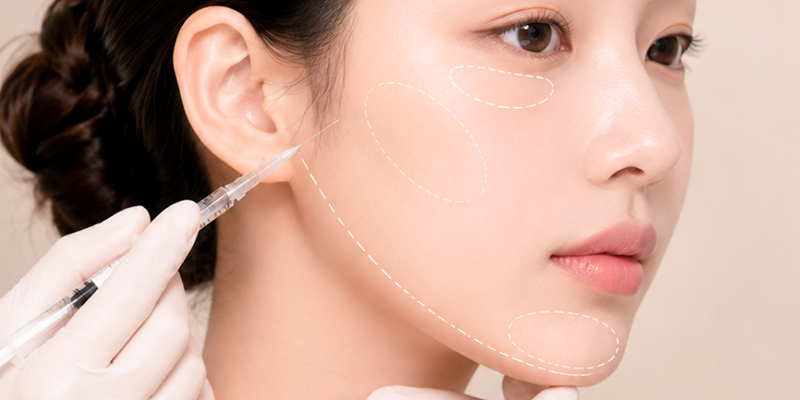
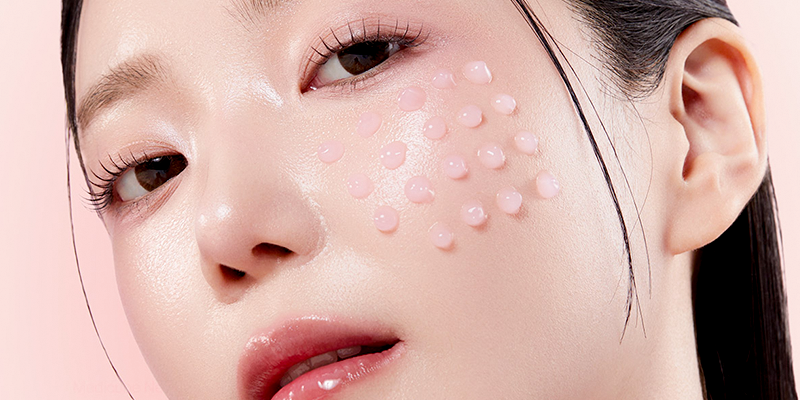
Collagen injections are delivered in an even, micro-droplet pattern across the midface to enhance skin firmness, refine surface texture, and restore a luminous, smooth finish. It is essential to distinguish skin quality from deep tissue loss: while collagen significantly improves dermal density and surface elasticity, cheeks experiencing significant volume depletion or hollows from sub-dermal fat loss require a targeted volumizing protocol (such as dermal fillers or bio-stimulators) rather than superficial collagen work alone.
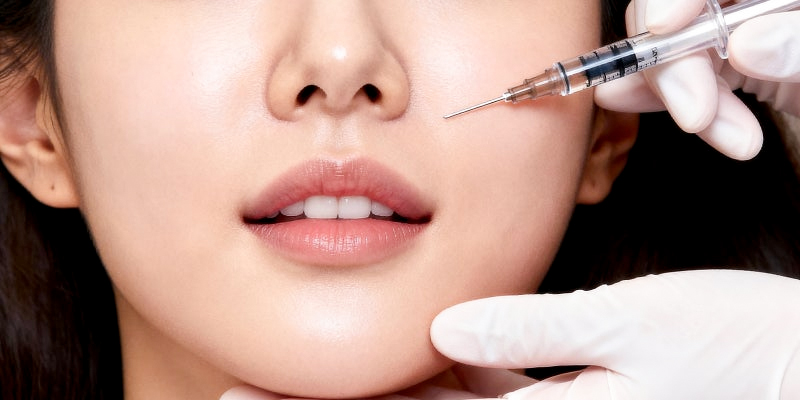
3. Shallow Acne Scars
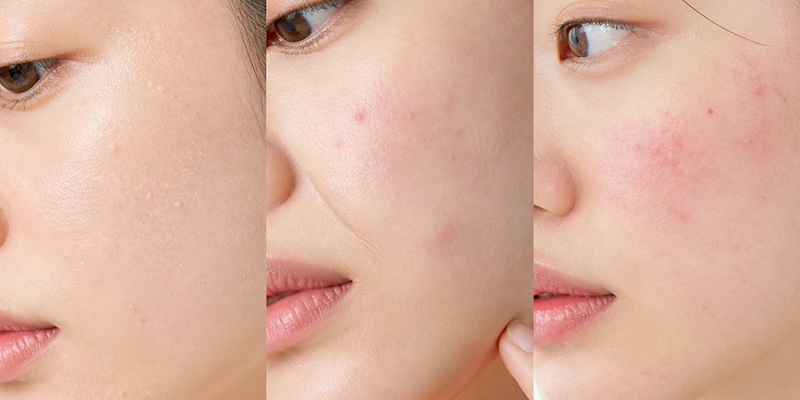
Injected directly beneath the scar floor so new connective tissue lifts it. It works on shallow, wide, soft scars. Ice-pick scars and scars tethered by fibrous bands usually need the base released first.
3. Nasolabial Folds, Jawline, and Neck
Often treated in the same visit. The fold and the jawline improve as the skin base thickens, and horizontal neck lines can change noticeably after two to three sessions.
Pigmented areas are a separate question. Collagen barely touches the cells that make melanin, so melasma and sun spots need pigment protocols running alongside rather than instead.
Benefits and Limits of Collagen Shots for the Face
Collagen shots for the face are a low-downtime option with a slow payoff, and both halves matter when planning a course. Some of the results of this treatment include:
- Needle marks that fade within a few hours to a day, so most people return to work the same day
- Facial proportions left intact, which avoids the inflated look people fear
- Access to thin-skinned zones such as the eye area, neck, and hands
- Results that hold about 12 months, because the collagen holding them is made by your own skin
- Compatibility with laser, radiofrequency, and focused ultrasound when a doctor sets the order and the gaps
The limits are equally specific:
- The visible change needs four to eight weeks, and a single session rarely does enough
- The usual course runs two to four sessions spaced two to four weeks apart
- Deep folds after age 40 sit outside its range and respond better to thread lifting, filler, or a combined structural plan
- Deep and fibrotic scars need release or laser alongside
- Maintaining the result means repeating the course after about a year
Besides, technique failures are the common issues in unqualified spas or clinics. Injection at the wrong depth, at the wrong dose, or with a product of unknown origin causes lumps and open wounds, so the setting matters as much as the material.
Recognizing Warning Signs After Injection
Ordinary reactions are small raised points at each needle site, mild redness, and occasional small bruises where vessel walls are thin. The bumps settle within 24 to 48 hours and the rest fades over a few days.
Seek special care and consultation in the following situations:
- Swelling that increases after day three rather than shrinking
- Spreading heat and redness with fever, which needs same-day assessment
- An itchy rash spreading beyond the injected area
- Hard nodules under the skin lasting past two weeks
- Skin turning pale or dusky right after injection, which needs treatment within hours
Who Is a Good Candidate for Collagen Injections?
Ideal candidates for collagen injections are those experiencing a decline in skin quality rather than deep structural volume loss. Primary clinical indications include:
- Thinning, Dry, or Slack Skin (Ages 28+): The primary group benefiting from treatment, where a structured protocol yields the most visible improvement in skin density.
- Fine Lines & Dull Tone Resistant to Topicals: Surface skincare has reached its limits, indicating the need for dermal-level restoration.
- Shallow Post-Acne Scars: Soft-bottomed, superficial acne scars lift as new connective tissue rebuilds within the dermal matrix.
- Post-Procedure Skin Support: Complements laser or microneedling treatments by reinforcing the skin matrix between device sessions.
Differentiating Dermal Quality vs. Structural Volume Loss
A quick self-assessment helps clarify your aesthetic needs prior to your clinical consultation:
- Pinch Test for Dermal Quality: Pinch the skin on your upper cheek—if it feels thin, lacks firmness, or springs back slowly, your concern is dermal collagen loss, which responds exceptionally well to collagen injections.
- Lighting Check for Volume Loss: If overhead lighting casts a deep shadow in hollowed areas (such as the temples or sub-malar cheeks), your primary concern is structural volume loss, which requires targeted volumizing treatments rather than collagen injections alone.
Natural collagen production slows around age 25 for most adults. Early, conservative protocols act as an effective preventive measure to maintain structural skin density before visible signs of aging advance.
Cases That Should Postpone Treatment
Some cases should wait rather than negotiate. Certain circumstances should prompt a delay:
- Active inflammatory acne or dermatitis at the site: Bring the inflammation under control first, because injecting through an active lesion spreads it.
- A wish to change the shape of the face: Hollow cheeks, a receding chin, and flat temples need volume, and collagen delivers almost nothing against that expectation.
- A history of serious animal-protein allergy: This needs specialist assessment before any animal-derived collagen line is considered, and a patch test may be advised.
- Anticoagulant therapy: Bruising and blood pooling risk rises, so the prescribing doctor decides the timing.
- Pregnancy or breastfeeding, and skin peeling after a peel or laser: Both call for postponement, in the second case until the outer skin layer has rebuilt.
Besides, oral and topical collagen do not substitute. Topical collagen holds moisture at the surface, while oral collagen is broken into amino acids in the gut and distributed wherever the body needs them, not steered to the face.
Caring for Skin in the First Two Weeks
Care in the first fortnight affects both recovery speed and how long the result holds. It is common to expect the following:
- First 24 hours: Keep the area clean and hands off the face, cool the skin gently if it feels hot, postpone makeup for 12 hours, and skip alcohol and heavily spiced food.
- Day two to day five: Use a gentle cleanser without scrubbing, moisturize consistently, apply sunscreen carefully, and pause retinol, AHA, BHA, and high-strength vitamin C.
- Day two to day five, activity: Avoid saunas, hot baths, swimming, and workouts that bring heavy sweating.
- From week two: Return to your usual routine as the doctor directs, and push laser, radiofrequency, and ultrasound lifting to the date they set.
- At the review appointment: Keep it, since the next session is timed against what the skin has actually done rather than against the calendar.
How to Choose a Collagen Injection Clinic in Ho Chi Minh City
The deciding factor is whether a doctor examines the skin, sets the dose, and performs the injection. That matters more than the size of the facility, because the result depends on reading the skin base correctly at the start.
Five checks are worth making before you commit:
- A specialist doctor scans your skin and builds the protocol: With a record kept across sessions rather than a fixed menu package.
- The active is traceable by source and concentration: You see the vial and the expiry date before it is reconstituted.
- The treatment room meets sterile standards: Single-use instruments, opened in front of you.
- The clinic can manage an unexpected reaction: With a direct contact channel for the first 48 hours.
- The plan states the number of sessions and the total course cost: At the consultation, not after the first visit.
The licensing tiers in the city are worth reading before a first appointment, since the tier decides what a facility may legally do.
Dermazeen Collagen Rejuvenation at Keangnam Korea
Keangnam Korea runs collagen rejuvenation for the face at 394-396 Cao Thang, District 10, Ho Chi Minh City, through Dermazeen. Its active system can include plant germ extract, marine-derived biological actives, and collagen type I.
- Rebuilding from underneath: The protocol switches the collagen-producing cells back on and supports pro-collagen type I along with the scaffold that holds collagen fibers in place, so the change is structural rather than surface-level.
- A protocol set after a skin scan: Dosing follows the skin’s measured condition, so a course is not stronger than the skin needs.
- One doctor across assessment and injection: This matters most in the thin skin around the eyes.
- One client per room in a sterile treatment room: The product is checked in front of you before it is prepared.
Skin feels more hydrated and smoother after the first visit, and elasticity, firmness, and tone shift across the full course. Mild redness, slight swelling, or a tingling feeling can follow a session and generally settle within 24 to 48 hours.
Your First Visit
A skin scan and an assessment of the skin’s biological age, an allergy and medication history, then a written plan naming the active, the number of sessions, the interval between them, and the total course cost. Bring a list of anything done in the past three months, including peels, laser, and microneedling. If your time in Vietnam is short, give the exact dates at the start, because the interval between sessions decides whether a full course fits the trip at all.
Is it safe to inject collagen into face skin at a beauty salon?
No. Injectable collagen is a class D medical device in Vietnam, the strictest classification, so it may only be used in a licensed medical facility and administered by a doctor. Sessions performed by technicians at the wrong depth or dose are the main source of lumps and open wounds.
How long do collagen injections for the face last?
Results hold about 12 months for most of those treated and sometimes longer, because the collagen holding the result is made by your own skin rather than implanted. Three things shorten it: the skin’s biological age, daily sun exposure, and lifestyle. A repeat course after about a year maintains the effect.
Does collagen injection change the shape of the face?
No. The injection works on the quality and thickness of the skin base and leaves facial proportions untouched, which is the main difference from filler. What shows is skin that looks thicker and firmer, not a changed outline. Hollow areas need a volume plan instead.
How many sessions does a course need?
The usual course runs two to four sessions spaced two to four weeks apart. Skin needs time to complete one renewal cycle and settle before the next session, and going sooner raises the inflammatory response rather than the result. The exact number comes from the doctor after a skin scan.
Can this be combined with laser or microneedling on the same trip?
Yes, when a doctor sets the order and the intervals. Collagen injection is often used to help the skin base recover between laser or microneedling sessions. Skin peeling after a recent peel or laser should heal first, so plan the sequence at the consultation rather than booking treatments back to back.
RELATED ARTICLES

Collagen Injection vs. Laser for Facial Skin: Cost, Recovery, and Fit
A collagen injection vs laser for aging facial skin, which is better? They are two distinct approaches to facial rejuvenation and do not replace each other. Lasers work from the outside in to correct surface texture and pigment, while injected
Collagen Shots for the Face vs. Mesotherapy: Aging Grades, Cost, and Results
Deciding between collagen shots for the face and mesotherapy comes down to identifying which layer of your skin is experiencing aging. Mesotherapy nourishes the superficial skin layers for quick surface hydration, whereas collagen shots for the face rebuild structural density
How Long Does a Fox Eye Thread Lift Last? Costs, Risks, and Results
A fox eye thread lift is a minimally invasive procedure that uses dissolvable barbed threads to suspend the outer corner of the eye (lateral canthus) and the eyebrow tail toward the temple. By gently pulling these soft tissues upward, the

What Is a Liquid Nose Job? Cost, Longevity and When Do Threads Work Better?
What is a liquid nose job? A liquid nose job (clinically known as liquid rhinoplasty) is a non-surgical procedure that reshapes the nose using precision injections of hyaluronic acid (HA) filler. The treatment takes 10 to 15 minutes, requires zero

Semi-Structural Rhinoplasty for a Low Bridge and Wide Tip: Cost and Recovery
Semi-structural rhinoplasty is a targeted surgical procedure that reshapes specific portions of the nose, typically modifying a broad, rounded tip with autologous cartilage while elevating a slightly low bridge with a biocompatible implant. The procedure takes 45 to 90 minutes

Non-Surgical Rhinoplasty Price in 2026: Cost by Filler and Thread Type
The non-surgical rhinoplasty price in Ho Chi Minh City, Vietnam, ranges from $230 to $1,720 (6 to 45 million VND) per treatment in 2026. The overall cost is determined primarily by the specific material and technique selected: The material used