Skip to content

What Is Korean Double Eyelid Surgery? Pros, Cons, and Cost in Vietnam, 2026
Korean double eyelid surgery is a minimally invasive procedure that creates a slim, natural-looking crease along the upper lash line, and in Vietnam it costs about 7,000,000 to 44,000,000 VND (roughly 265 to 1,670 USD) in 2026, depending on the technique and facility. The whole procedure takes only 30 to 45 minutes under local anesthesia, and most individuals return to normal activities within a week.
This guide explains what Korean double eyelid surgery is, who it suits, the honest pros and cons, and exactly what to expect on price.
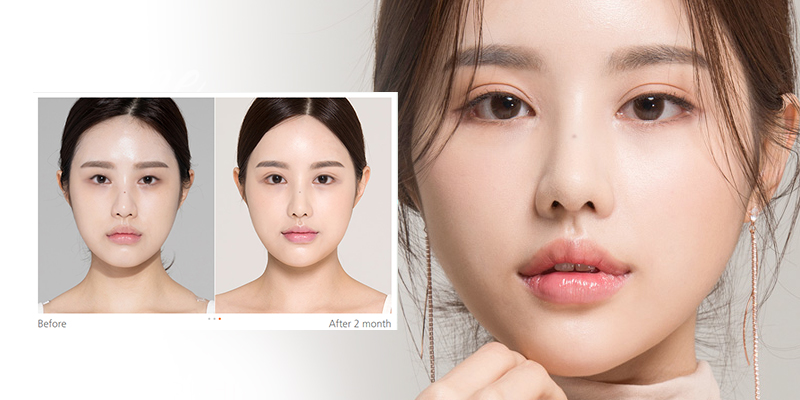
[Korean double eyelid surgery creates a natural crease that suits the Asian eye structure]
What Is Korean Double Eyelid Surgery?
Korean double eyelid surgery is a small surgical procedure that forms a new eyelid crease along the upper border of the tarsal plate (the firm cartilage layer inside the eyelid), rather than forcing an artificial fold higher up the lid. Through a minimal incision, the surgeon removes excess skin and herniated fat, then anchors the skin edge directly to the natural tarsal border with ultra-fine cosmetic sutures.
Because the crease follows the eye’s own anatomy, the result is a slim, well-defined double eyelid that moves naturally when you blink and leaves no visible trace when your eyes are closed.
The difference between the Korean approach and Western-style blepharoplasty: instead of chasing a deep, heavy European fold, Korean double eyelid surgery respects the natural Asian eye structure and builds a crease that stays in proportion with the rest of the face.
The technique is also considered a rejuvenating procedure. By removing aging skin and puffy fat pockets, it restores brightness and expression to eyes that have started to look tired or hooded, which is why Asian double eyelid surgery in the Korean style remains the most requested eye procedure in Vietnam, including among public figures.
Who Should Consider Korean Double Eyelid Surgery?
This procedure suits both men and women who want a clear, balanced double crease. Age is the single most useful guide when choosing between techniques.
1. Individuals over 30 benefit most from the surgical method
At this age, the orbital septum weakens, fat begins to herniate into puffy pockets, and the upper lid skin loosens enough to hide the old crease and dull the eyes. Non-incisional stitch methods cannot remove that excess tissue, so a full Korean double eyelid surgery is the appropriate solution. It clears the sagging skin and fat, lifts the lid, and restores a bright, rested look that would otherwise demand heavy daily makeup.
2. Individuals under 30 with tight, elastic skin
When there is no excess skin or fat, a non-incisional stitch method (thread anchoring through micro-punctures) is often the better first option. It takes about 20 minutes, involves no cutting, and is reversible, but the crease typically holds only 3 to 5 years before loosening.
3. Having particular eye concerns
Beyond age, candidates typically include those with the following eye concerns, each of which the Korean technique is designed to correct:
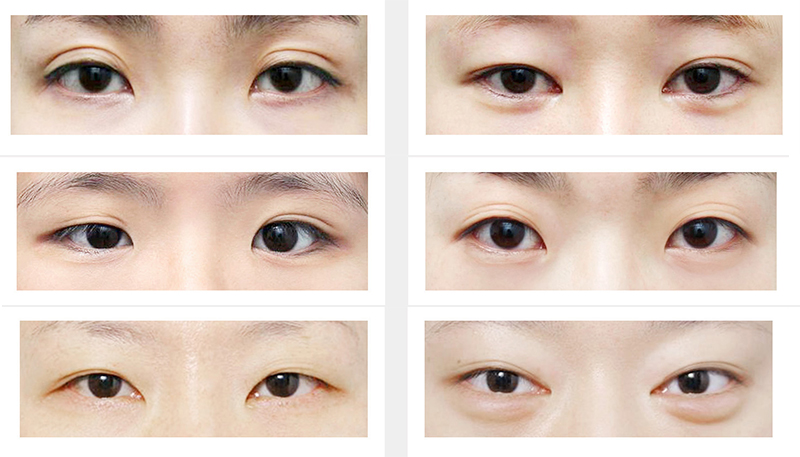
[Korean double eyelid surgery suits a wide range of clients and eye concerns]
Candidates typically include those with:
- Monolids: No natural crease, making the eyes look smaller and flatter.
- Hidden or partial creases: A fold that exists but is covered by skin or too faint to see.
- Mild congenital ptosis: A drooping upper lid that partially covers the pupil.
- Asymmetric eyelids: Two creases of different heights or shapes.
- Small eyes or narrow eye corners: Often combined with corner-opening procedures.
- Aging eyelids: Sagging skin and fat pads that hide the old crease and weigh the eye down.
Individuals under 30 with tight, elastic skin and no excess fat may be better served by a non-incisional stitch method, which is faster and reversible but lasts only 3 to 5 years.
The Pros and Cons of Korean Double Eyelid Surgery
The pros and cons of double eyelid surgery in the Korean style come down to a trade-off between a natural, long-lasting result and the demand it places on surgical skill.
| Pros | Cons |
| Natural looking double eyelid surgery result: a slim crease that follows the eye’s own anatomy, with no “operated” look | Not suited to those who want a very deep, wide Western-style fold |
| Minimal invasion: only the soft tissue outside the eyeball is touched, so vision is unaffected | Results depend heavily on the surgeon’s skill; poor technique can cause asymmetry or secondary ptosis |
| Short procedure (30 to 45 minutes) under local anesthesia, home the same day | A micro-fine incision line still needs 1 to 3 months to fade fully into the crease |
| Fast recovery: clinical swelling settles in about 5 to 7 days with modern techniques | Cannot fix problems beyond the soft tissue, such as heavy brow sagging or orbital bone structure |
| Long-lasting: 10 to 15 years, often permanent, depending on natural aging | Requires strict aftercare (diet, no rubbing) during the first weeks |
The natural result: The strongest advantage. Because the crease is anchored to the natural tarsal border, it is calibrated to each face during the marking stage, producing a balanced fold that is very hard to identify as cosmetic work. One procedure typically delivers a lifetime result.
The scar question: Double eyelid surgery scars are a common worry, and an honest answer helps. There is always a micro-incision line, but with plasma-assisted cutting and ultra-fine biological sutures, the line sits hidden inside the new fold and fades to a flat, skin-toned mark within 3 to 6 months. Visible scarring is almost always the result of poor technique or poor aftercare, not the method itself.
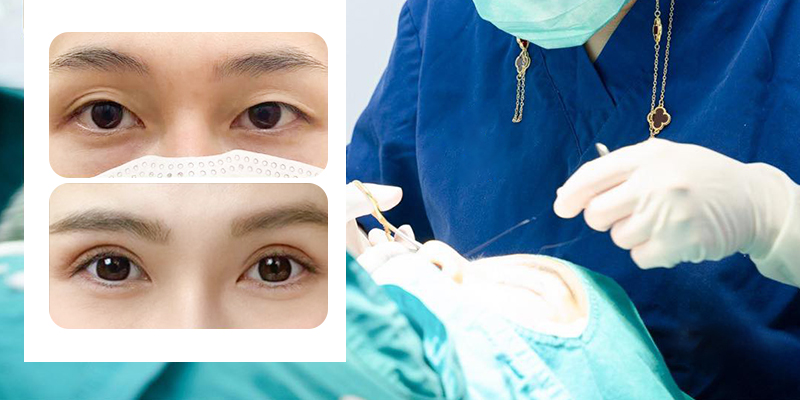
[Korean double eyelid surgery has a strong safety profile when performed at licensed facilities]
Korean Double Eyelid Surgery Recovery Time
Korean double eyelid surgery recovery time is one of the technique’s biggest selling points. A typical timeline looks like this:
- Days 1 to 3: Mild swelling and tightness. Cold compresses (wrapped, never direct ice) reduce fluid buildup.
- Days 4 to 7: Bruising fades; switch to warm compresses to speed circulation. Stitches are removed around day 7, or not at all if dissolvable sutures were used.
- Week 2 onward: Most individuals return to work and light daily activity within 5 to 7 days.
- Month 1: The crease shape stabilizes.
- Months 3 to 6: The incision line fully flattens and blends into the fold.
During the first weeks, the standard local guidance is to avoid water spinach, beef, sticky rice, seafood, poultry, eggs, alcohol, and tobacco, all of which can slow healing or affect scar quality, and to avoid rubbing the eyes entirely.
Where Should You Have Korean Double Eyelid Surgery?
The facility matters as much as the technique. Licensed clinics with Ministry of Health certification, specialist surgeons, and sterile operating standards are non-negotiable for any eyelid procedure. Keangnam Korea is one of the established addresses in Vietnam for this surgery, and three factors stand out.
- Exclusive Korean technology with AI simulation: The Perfect Eyes technique uses BernaStitch hidden intradermal suturing, transferred exclusively from Korea’s LUX Group. It minimizes infection risk, hides the suture line completely, and holds up to 5 times longer than older methods. Before any surgery, the Face AI Pro simulation system shows a preview of the final result with up to 99% accuracy, so you see the outcome before committing.
- Surgeons with over 10 years of experience: Each crease is measured, drawn, and calibrated to the individual face rather than applying one template to every client. The final result is guaranteed to match the AI simulation by at least 99%, backed by long-term warranty.
- Modern, sterile facilities: All equipment and materials meet Ministry of Health sterilization standards before every procedure, covering safety before, during, and after surgery.

[Korean double eyelid surgery technology at Keangnam Korea, including Face AI Pro simulation]
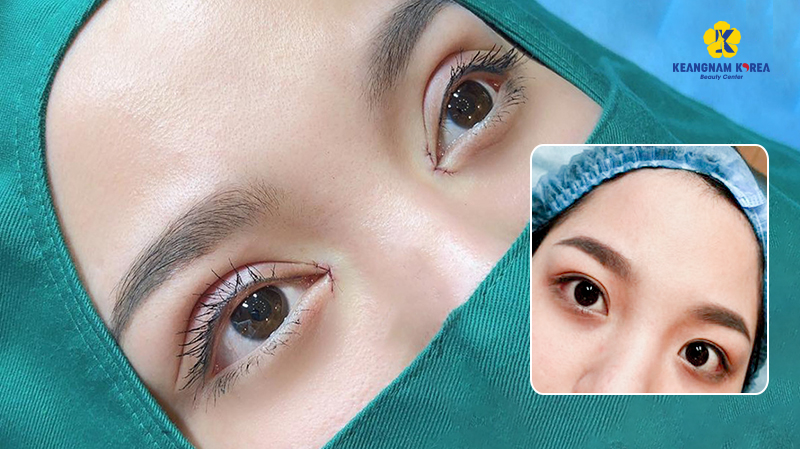
[Real before and after results of Korean double eyelid surgery at Keangnam Korea]
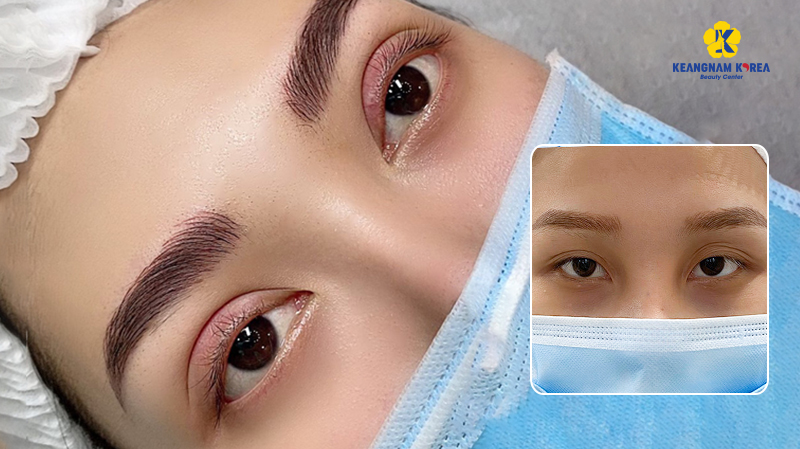
[Before and after Korean double eyelid surgery showing a natural, balanced crease]
How Much Does Korean Double Eyelid Surgery Cost?
Korean eyelid surgery cost in Vietnam ranges widely by technique and facility tier. The table below reflects 2026 market pricing. USD figures are approximate, based on an exchange rate of about 26,300 VND to 1 USD.
| Service | Reference price (VND) | Approximate (USD) |
| Non-incisional stitch method (nhấn mí) | 3,000,000 – 25,000,000 | 115 – 950 |
| Korean double eyelid surgery (upper lid) | 7,000,000 – 44,000,000 | 265 – 1,670 |
| Public hospital basic crease creation | from 3,000,000 | from 115 |
| Eye corner opening add-on (inner/outer) | 5,600,000 – 25,000,000 | 215 – 950 |
| Revision of a failed eyelid procedure | 12,000,000 – 60,000,000 | 455 – 2,280 |
Several factors move the final number: the condition of the eyelids (excess skin, fat volume, asymmetry), the technology used (plasma blades and premium sutures cost more but reduce swelling), and any add-on procedures such as corner opening, brow lifting, or under-eye rejuvenation. High-tech packages usually include warranties of 10 to 20 years or lifetime coverage.
→ Read more: Keangnam Korea’s perfect eye surgery technique
RELATED ARTICLES

Alarplasty and Rhinoplasty Comparison: Which Procedure Fits Your Nose Shape
Selecting between alarplasty and rhinoplasty depends on whether your lower nose appears wide due to flared soft tissue or a low, unsupported structural bridge. Alarplasty isolates and reshapes the nostril wings at the base, whereas rhinoplasty elevates, straightens, or rebuilds
Nose Wing Reduction: Is Alarplasty Worth It? Pros, Cons, and Recovery Time
A nose wing reduction (alarplasty) is a surgical option for those whose nostril wings are naturally thick, wide, or flared while their nasal bridge height and tip projection already suit their overall facial proportions. This procedure selectively reshapes or excises

Alar Base Reduction Technique: Rolling vs. Excision Comparison
An alar base reduction technique narrows flared or wide nostrils by either folding the nostril rim inward with internal sutures or excising a targeted strip of tissue. In Ho Chi Minh City, Vietnam, plastic surgeons perform four main surgical variations
Top 5 Rhinoplasty Clinics in Ho Chi Minh
Rhinoplasty clinics in Ho Chi Minh City offer safe cosmetic nose surgery: Gangwhoo Aesthetic Hospital, JW Korean Aesthetic Hospital, Kangnam Aesthetic Hospital, Thu Cúc Aesthetic Hospital, and Keangnam Korea. In 2026, market rates for cosmetic nose surgery across these facilities

Collagen Injection vs. Laser for Facial Skin: Cost, Recovery, and Fit
A collagen injection vs laser for aging facial skin, which is better? They are two distinct approaches to facial rejuvenation and do not replace each other. Lasers work from the outside in to correct surface texture and pigment, while injected

Collagen Shots for the Face vs. Mesotherapy: Aging Grades, Cost, and Results
Deciding between collagen shots for the face and mesotherapy comes down to identifying which layer of your skin is experiencing aging. Mesotherapy nourishes the superficial skin layers for quick surface hydration, whereas collagen shots for the face rebuild structural density