Skip to content

S-Line vs L-Line Rhinoplasty Comparison, Which Nose Shape Suits You?
The core difference in the S-Line vs L-Line rhinoplasty decision comes down to the bridge profile. An S-line rhinoplasty creates a soft, gently curved bridge with a rounded tip for a natural Korean-style look, while an L-line rhinoplasty builds a high, perfectly straight bridge with a sharper, more projected tip for a bold Western-style profile.
Both methods are typically performed as structural rhinoplasty in Vietnam, where prices range from 30,000,000 to 77,000,000 VND (about 1,140 to 2,940 USD) for a standard structural case, and from 80,000,000 to 220,000,000 VND (about 3,050 to 8,390 USD) when rib cartilage is required.
This guide compares the two shapes across anatomy, skin safety, materials, ideal face types, and cost, so you can see which line fits your features.

What Is S-Line Rhinoplasty?
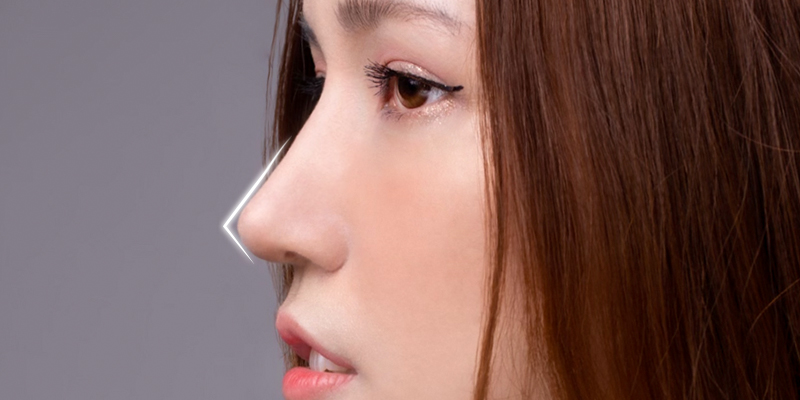
S-Line rhinoplasty is a nose reshaping technique that creates a soft, flowing curve from the area between the brows down to a slightly lifted, rounded tip, forming a gentle “S” when viewed in profile. The starting point of the curve (the radix) keeps a slight natural dip where the forehead meets the bridge, which is exactly what makes the result read as a natural looking rhinoplasty rather than an obvious implant.
Korean S-Line rhinoplasty is the signature of modern Korean aesthetics and one of the most requested asian rhinoplasty styles. The technique usually combines a high-grade implant for the bridge with the individual’s own cartilage (ear or septal cartilage) to build and cushion the tip. This blend supports a delicate, harmonious result that stays in proportion with softer facial features.
The shape is also mechanically forgiving. Because the curve distributes tension evenly along the bridge, the pulling force on the skin is not concentrated at a single point. This preserves blood flow at the tip and makes the S-line a safe option even for individuals with thin nasal skin, which is common in Asian anatomy.

What Is L-Line Rhinoplasty?
L-Line rhinoplasty creates a tall bridge that runs in a perfectly straight line from the radix to the tip, then turns at a defined angle toward the upper lip, forming an “L” in profile. The tip is longer, slimmer, and more projected than in an S-line, and the nostrils take on a narrow, elongated shape.
This is the classic straight bridge rhinoplasty, modeled on Western facial proportions. The nasofrontal angle is wider and the bridge starts higher under the forehead, which produces a striking, sculpted side profile. A practical bonus: the higher, straighter bridge can visually soften prominent cheekbones and balance a broad or angular face.
The tradeoff is mechanical stress. An L-line pushes the tip forward with concentrated force, so the skin at the tip bears significantly more tension than in an S-line. For individuals with thin or inelastic nasal skin, this raises the long-term risk of skin thinning, redness, or implant visibility. Surgeons manage this by building the tip support from strong autologous material, often rib cartilage, and wrapping the tip in the client’s own cartilage or a biological membrane to spread the pressure.
What Is the Difference Between S-Line and L-Line Rhinoplasty?
The S-Line vs L-Line rhinoplasty comparison rests on three anatomical and technical differences, not just visual taste.
Facial Geometry and Proportions
- Bridge shape: The S-line keeps a slight natural dip at the radix and curves softly into the tip. The L-line runs flat and straight from forehead to tip with no dip at all.
- Nasal angles: The S-line uses a deeper nasofrontal angle and a moderately lifted nasolabial angle, giving a rounded, “close-set” tip. The L-line opens both angles wider, starting the bridge higher and pushing the tip up and forward for a sharper look.
- Tip structure: The S-line tip is full and rounded with refined nostrils. The L-line tip is elongated and pointed, with narrow, upright nostril openings.
Skin Thickness and Long-Term Safety
- S-line and thin skin: Tension is distributed evenly along the curved bridge, protecting the small blood vessels that feed the tip. This makes the S-line clinically suitable for most Asian nasal skin, including thinner skin with limited soft tissue.
- L-line and thin skin: The forward force concentrates at the tip. If the skin is thin or has poor elasticity, sustained tension can reduce capillary blood flow and lead to skin thinning, a shiny red tip, or visible implant edges over time. For this reason, an L-line is relatively contraindicated for thin nasal skin unless the tip is reinforced with sturdy autologous cartilage and protective grafts.
Implant Materials and Technique
Both shapes rely on structural rhinoplasty to hold their form long term. In a full structural procedure, the surgeon releases the old cartilage framework, rebuilds the columella (the central support strut), shapes the bridge with an implant, and reconstructs the tip with the individual’s own cartilage.
- Bridge material: Traditional flexible silicone is easy to carve but has a smooth surface that does not bond to tissue, so it can shift or deviate over time and carries a higher rate of late complications such as capsular contracture. Premium ePTFE implants (Surgiform, Nanoform) contain millions of micropores that let blood vessels and fibrous tissue grow through the material, anchoring it firmly to the nasal bone and sharply reducing the risk of displacement and redness.
- Tip material: Autologous cartilage is standard for the tip in both shapes. An S-line typically needs septal or ear cartilage. An L-line often requires rib cartilage, because only a rib graft is strong enough to build a columella that resists the constant skin tension of a high straight profile.

Comparison Table for S-Line vs L-Line Rhinoplasty
| Criteria | S-Line Rhinoplasty | L-Line Rhinoplasty |
| Bridge shape | Soft curve with a slight natural dip at the radix | Straight, high line from forehead to tip |
| Nose tip | Rounded, full, gently lifted | Elongated, pointed, strongly projected |
| Overall vibe | Natural, soft, youthful | Sharp, bold, Western-influenced |
| Ideal face shapes | Round, oval, heart-shaped, softer Asian features | Square, angular, long faces, prominent cheekbones |
| Best for | Women seeking a natural looking rhinoplasty | Men, or women who prefer a dramatic sculpted profile |
| Skin requirement | Suits most skin, including thin nasal skin | Needs thicker, elastic skin or strong autologous tip support |
| Typical tip cartilage | Ear or septal cartilage | Often rib cartilage for a strong columella |
| Longevity | Permanent with structural technique; 15 to 20 years with basic tip-wrap methods | Permanent with structural technique and autologous support |
| Revision flexibility | Easier to adjust later | Harder to convert or lower once healed |
Is S-Line or L-Line Rhinoplasty Better?
Neither shape is objectively better. Clinical comparisons consistently conclude that the right choice depends on facial anatomy, skin quality, and personal style rather than on any inherent superiority of one line.
- The S-line is safer across a wider range of skin types and reads as more natural, which is why it dominates requests among Asian women.
- The L-line delivers a more dramatic profile and photographs strikingly from the side, but it demands better skin elasticity, stronger structural support, and a more experienced surgeon to achieve safely.
The S-line prioritizes harmony and low long-term risk, while the L-line prioritizes height and definition at the cost of stricter anatomical requirements. When the tissue cannot support an L-line, forcing one raises complication risk. When the face is angular and the skin is robust, an L-line can look outstanding.
Which Nose Shape Should You Choose for Your Face?
Rhinoplasty for asian face proportions is not one-size-fits-all, and the most reliable guide is your existing bone structure and features.
- Choose the S-line if: You have a round, oval, or heart-shaped face with soft features typical of Asian women. You want a nose that looks like it was never operated on. You have thin nasal skin or limited soft tissue at the tip. You prefer a gentle, friendly, approachable look.
- Choose the L-line if: You have a square, angular, or long face, prominent cheekbones, or a defined V-line jaw. You favor bold makeup and a sharp, editorial style. You are a man seeking a stronger, more masculine profile, or a woman drawn to a Western-influenced look. Your nasal skin is reasonably thick and elastic.
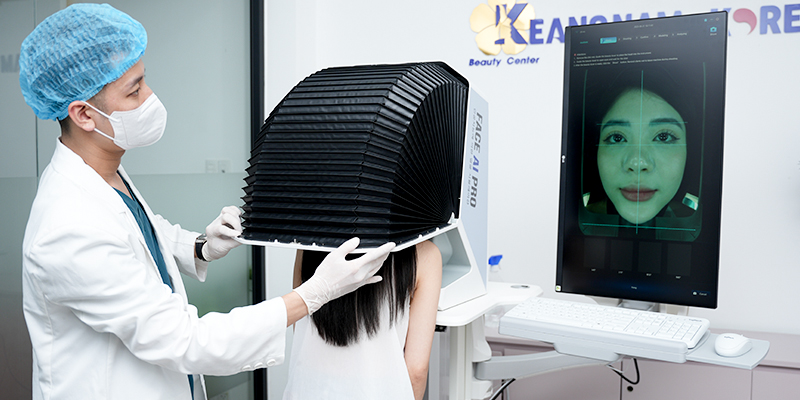
- When in doubt: A direct examination is worth more than any rule of thumb. Reputable clinics now use 3D facial analysis and AI simulation to preview both shapes on your own face before committing. Keangnam Korea, for example, offers Face AI Pro simulation that analyzes facial proportions against golden-ratio benchmarks and projects the post-surgery result with high accuracy, so you can compare your own S-line and L-line previews side by side.
How Much Do S-Line and L-Line Rhinoplasty Cost in Vietnam?
Both shapes are priced by technique and material rather than by the shape itself. USD figures below are approximate, based on an exchange rate of about 26,200 VND to 1 USD.
| Technique | Price range (VND) | Approximate (USD) |
| Basic implant-only augmentation (bridge only, simple cases) | 14,000,000 – 22,400,000 | 530 – 850 |
| Tip-wrap with ear cartilage (basic S-line) | 20,000,000 – 27,500,000 | 760 – 1,050 |
| Structural or semi-structural S-line / L-line (Surgiform, Nanoform) | 30,000,000 – 77,000,000 | 1,140 – 2,940 |
| Rib cartilage rhinoplasty (complex L-line, revision cases) | 80,000,000 – 220,000,000 | 3,050 – 8,390 |
A few notes on how the shape affects the final quote.
- S-line cases: Most are completed with structural or semi-structural techniques using septal or ear cartilage, so they usually stay within the 30,000,000 to 77,000,000 VND band. At Keangnam Korea, structural S-line and L-line procedures run 30,000,000 to 60,000,000 VND (about 1,140 to 2,290 USD).
- L-line cases: When the tip requires rib cartilage for a strong columella, the price moves into the rib cartilage tier, which also involves hospital-grade anesthesia and a chest donor site.
- Safety floor: Avoid any surgical rhinoplasty offered below 5,000,000 VND (about 190 USD). At that price point, implant quality, sterility, and the operator’s anatomical training are all in question, and the cost of correcting a failed result far exceeds the initial savings.
How Do You Choose a Safe Clinic for S-Line or L-Line Rhinoplasty?
Structural rhinoplasty reshapes the entire framework of the nose, so the choice of surgeon and facility matters more than the choice of shape. Four checks protect you.
- Verify the surgeon’s license directly: The operating surgeon must hold a plastic surgery practice certificate issued by the Ministry of Health or the provincial Department of Health. Established surgeons often list advanced training in Korea, the US, or France and membership in professional bodies such as VSAPS (Vietnam Society of Aesthetic Plastic Surgery).
- Insist on meeting the surgeon before anesthesia: A documented risk in the industry is “ghost surgery,” where the client consents to a well-known surgeon but the operation is performed by an unlicensed assistant after sedation. Refuse any process where only sales consultants examine you, ask the named surgeon to confirm the plan face to face in the operating room, and require the surgeon’s name in writing on the surgical record.
- Confirm the facility type: Structural and rib cartilage rhinoplasty must be performed in a licensed aesthetic hospital or general hospital operating room, never in a spa or standard clinic room. Sterile, positive-pressure operating theaters and 3D CT imaging are the standard at accredited facilities.
- Review real results and written pricing: A trustworthy center shows verifiable before-and-after cases for both S-line and L-line work and provides transparent, itemized quotes before any commitment.
Keangnam Korea is one of the established names for structural S-line and L-line rhinoplasty in Vietnam, combining examination by senior surgeons with master’s and doctoral-level training, Face AI Pro simulation, and clear pricing before any decision is made. The S-line remains the most requested option among female clients there for its natural, elegant result.


→ Read more: Nose lift at Keangnam Korea
Is S-line or L-line rhinoplasty better?
Neither is universally better. The S-line suits most Asian faces and thin skin because it distributes tension evenly and looks natural. The L-line creates a bolder straight profile but requires thicker, elastic skin and stronger cartilage support. The safest answer comes from a direct assessment of your skin and bone structure.
Can I change from an L-line to an S-line nose shape later?
Yes, conversion is possible through revision rhinoplasty. The surgeon removes or lowers the straight implant and rebuilds a curved profile. However, the dissection is more complex than a first surgery, and success depends on how much healthy tissue and usable cartilage remain, so the revision should be planned by a surgeon experienced in reconstructive cases.
Does L-line rhinoplasty work on thin skin?
It is relatively contraindicated. The L-line concentrates force at the tip, and thin skin under constant tension risks redness, thinning, and implant visibility. If an L-line is still desired, the surgeon must reinforce the tip with sturdy autologous cartilage (often rib) and protective grafts to spread the pressure.
Is rib cartilage required for L-line rhinoplasty?
Often, yes. The high straight profile needs a columella strong enough to resist skin tension long term, and rib cartilage provides the most robust support. Simpler L-line cases with good native septal cartilage may not need it, which is one reason quotes vary widely between individuals.
How long do S-line and L-line results last?
Durability follows the technique, not the shape. Full structural rhinoplasty with quality ePTFE material and autologous tip cartilage is designed to be permanent. Basic tip-wrap methods last about 15 to 20 years, and implant-only augmentation typically 10 to 25 years before replacement is considered.
How long is recovery after S-line or L-line rhinoplasty?
Structural procedures take 60 to 120 minutes and require 10 to 15 days of initial recovery before normal daily activity. Rib cartilage cases extend this to 15 to 20 days because of the chest donor site. The final shape settles over 1 to 3 months.
RELATED ARTICLES

Alarplasty and Rhinoplasty Comparison: Which Procedure Fits Your Nose Shape
Selecting between alarplasty and rhinoplasty depends on whether your lower nose appears wide due to flared soft tissue or a low, unsupported structural bridge. Alarplasty isolates and reshapes the nostril wings at the base, whereas rhinoplasty elevates, straightens, or rebuilds
Nose Wing Reduction: Is Alarplasty Worth It? Pros, Cons, and Recovery Time
A nose wing reduction (alarplasty) is a surgical option for those whose nostril wings are naturally thick, wide, or flared while their nasal bridge height and tip projection already suit their overall facial proportions. This procedure selectively reshapes or excises
Alar Base Reduction Technique: Rolling vs. Excision Comparison
An alar base reduction technique narrows flared or wide nostrils by either folding the nostril rim inward with internal sutures or excising a targeted strip of tissue. In Ho Chi Minh City, Vietnam, plastic surgeons perform four main surgical variations
Top 5 Rhinoplasty Clinics in Ho Chi Minh
Rhinoplasty clinics in Ho Chi Minh City offer safe cosmetic nose surgery: Gangwhoo Aesthetic Hospital, JW Korean Aesthetic Hospital, Kangnam Aesthetic Hospital, Thu Cúc Aesthetic Hospital, and Keangnam Korea. In 2026, market rates for cosmetic nose surgery across these facilities

Collagen Injection vs. Laser for Facial Skin: Cost, Recovery, and Fit
A collagen injection vs laser for aging facial skin, which is better? They are two distinct approaches to facial rejuvenation and do not replace each other. Lasers work from the outside in to correct surface texture and pigment, while injected

Collagen Shots for the Face vs. Mesotherapy: Aging Grades, Cost, and Results
Deciding between collagen shots for the face and mesotherapy comes down to identifying which layer of your skin is experiencing aging. Mesotherapy nourishes the superficial skin layers for quick surface hydration, whereas collagen shots for the face rebuild structural density