Skip to content


Temporal Lift: What It Is, Cost, Scars & the Fox-Eye Effect
A temporal lift (temple lift) is a minimally invasive surgery that tightens sagging skin at the temples through a small incision hidden in the hairline, lifting the brow tail and the outer corner of the eye. It suits ages 30–45, takes 60–90 minutes, needs 3–5 days of downtime, and results typically last 7–10 years.
If your eyes have started to look tired even when you are well rested, the temples are usually the reason. This area is one of the first parts of the face to loosen with age, and when it drops it pulls the brow tail and outer eyelid down with it. This guide explains how a temporal lift corrects that, what it costs in Vietnam, and how it compares with threads, filler, and a full facelift.

What is a temporal lift (temple lift)?
A temporal lift is a surgical procedure that rejuvenates the upper third of the face by re-suspending the tissue at the temples. The surgeon makes a small incision concealed behind the hairline, releases the loosened tissue, then pulls the deeper muscle layer (the SMAS) upward and outward before fixing it in its new position. The skin follows the lifted foundation, so the result reads as rested rather than stretched.
The procedure is often described as a branch of the mini facelift, because it treats one zone instead of the whole face. A temporal lift addresses the area from the temples to the outer eye: drooping brow tails, hooded outer eyelids, and crow’s feet. It does not treat the mid-face, jawline, or neck, which is exactly why its recovery is measured in days rather than weeks.
When should you consider a temple lift?
Not every tired-looking eye needs surgery. Temple aging progresses through recognizable stages, and the right response depends on which stage you are actually in:
- Stage 1 — Early lines. Crow’s feet appear only when you smile, and the brow tail still sits above the bony rim. At this stage surgery adds little, and skin-quality treatments or energy-based tightening are usually the more sensible spend.
- Stage 2 — The “sad eye” stage. The brow tail has visibly dropped, the outer eye slants downward, and crow’s feet show at rest. Friends start asking if you are tired or upset. This is the classic indication for a temporal lift.
- Stage 3 — True hooding. Sagging temple skin folds onto the outer eyelid, the upper lid feels heavy, and makeup smudges into the fold. A temporal lift is still the core fix here, sometimes combined with upper-eyelid surgery for the excess lid skin itself.
What does a temporal lift improve?
One reason this procedure has grown so quickly is that a single small incision changes several things at once. The improvements clients notice most:
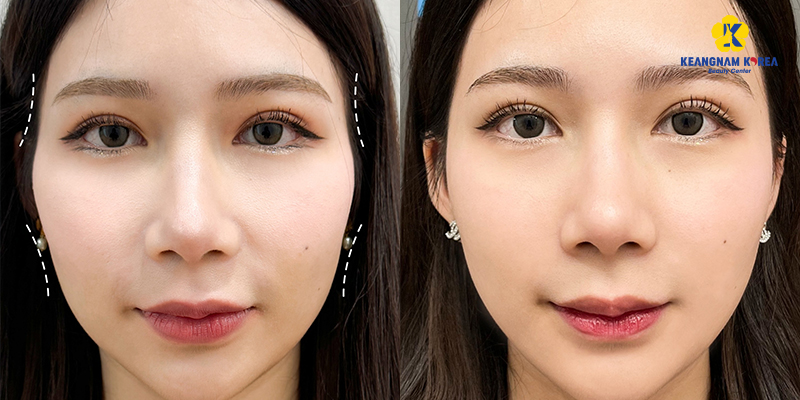
- A lifted brow tail (temporal brow lift effect). The outer third of the brow rises back to its youthful position, opening the whole upper face.
- The fox-eye / cat-eye effect. As the outer corner is drawn gently up and out, the eye takes on the subtly elongated, slightly lifted shape behind the fox eye surgery trend, achieved here with your own tissue rather than implants or visible threads.
- Smoother crow’s feet. Re-draping the temple skin softens the wrinkles fanning from the outer eye.
- Corrected sagging outer eyes. The heavy, hooded look at the outer eyelid lightens, and eyes read larger and more awake.
- A natural overall change. Because only the upper third moves, the face still looks like you. Most people around you will register “fresher,” not “operated.”
How is an endoscopic temple lift performed?
The endoscopic technique is the current standard because it lifts deeper tissue through smaller openings. Instead of a long incision, the surgeon works through 1.5–2 cm openings behind the hairline with a micro-camera guiding every movement. A typical procedure runs as follows:
- Design and marking. The surgeon maps the lift vector, how far the brow tail and outer corner should move, against your facial proportions.
- Anesthesia. Local anesthetic with light sedation is standard, so you feel nothing during surgery without the risks of full general anesthesia.
- Endoscopic release. Through the small openings, the surgeon frees the tissue that has slipped, viewing nerves and vessels on screen the whole time.
- SMAS fixation. The deep layer is repositioned and anchored securely, which is what makes the result last for years instead of months.
- Closure. The openings are closed with fine sutures fully hidden inside the hair.
Will a temple lift leave visible scars?
Scarring is the most common fear at consultation, and for this procedure it is also the most answerable one. The incisions sit 1–2 cm behind the hairline, so the healed lines are covered by hair even when it is wet or pulled back. With fine suturing, temporal lift scars typically fade to pale lines that even a hairdresser has to search for.
Recovery follows a predictable timeline:
- Days 1–3: mild swelling and a feeling of tightness at the temples, managed with cold compresses and simple pain relief.
- Days 5–7: stitches out; most clients return to work and light social life.
- Weeks 2–4: residual swelling settles and the new brow position softens into place.
- Month 3: the final, stable result.
Two aftercare rules protecting the scar are to keep the incision dry for the first 48 hours, and avoid pulling hairstyles or hair dye for the first month.
Temple lift, mini facelift and full facelift comparison
Each method suits a different zone of the face. The quickest way to choose the right method is matching the surgery to where your aging actually shows. If your concern is the eye area and temples while your jawline still holds, a full facelift is more surgery, more downtime, and more money than your face needs. If jowls and neck laxity are already prominent, a temple lift alone will disappoint you.
| Temple lift | Mini facelift | Full facelift | |
| Zone treated | Upper third: temples, brow tail, outer eye | Lower cheeks and jawline | Whole face and neck |
| Typical age | 30–45 | 40–50 | 50+ |
| Anesthesia | Local + sedation | Local + sedation | General |
| Downtime | 3–5 days | 7–10 days | 2–3 weeks |
| Results last | 7–10 years | 5–8 years | 10+ years |
Surgery, threads, filler, or fat graft: which actually fits your temples?
Temple concerns split into two different problems, and mixing them up is the most expensive mistake in this area. Hollowness is a volume problem; sagging is a laxity problem. Each option below solves one of them:
- Temple filler (6–18 months). Hyaluronic-acid filler refills sunken, “gaunt” temples in a single session with no downtime. It restores volume but does not lift anything, so it suits hollow temples on skin that is still firm. In Ho Chi Minh City expect roughly 10–30 million VND depending on the filler and volume used.
- Thread lift (1–3 years). Dissolvable lifting threads placed under the skin give a modest immediate lift and stimulate collagen. They fit early Stage 2 sagging for clients who want to avoid surgery, accepting that the effect fades as the threads dissolve. Market range is around 15–40 million VND.
- Fat grafting (2–5 years). Your own purified fat is transferred to the temples. It is the natural-feel option for hollowness, though survival of the fat varies by individual, and some clients need a touch-up round. Roughly 20–40 million VND.
- Endoscopic temple lift (7–10+ years). The only option on this list that repositions the deep tissue itself, which is why it is the answer for true sagging: dropped brow tails, hooded outer eyes, folded temple skin. The average cost in Vietnam is about 30–60 million VND.

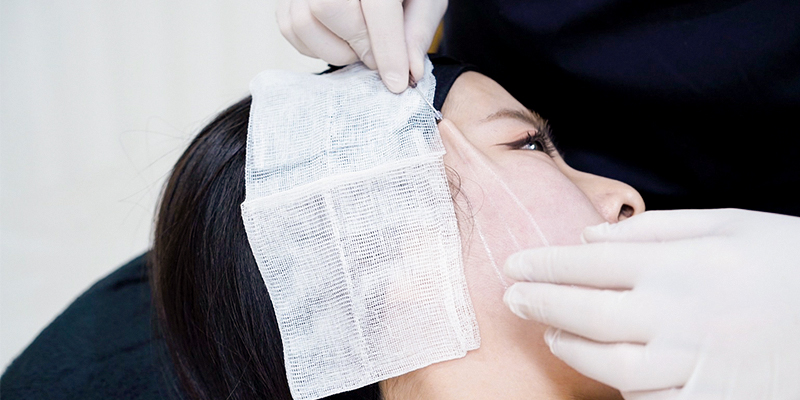
The deciding question is your problem related to volume or laxity. Filler poured into a sagging temple adds weight to tissue that is already slipping; threads placed in a heavily hooded eye buy one to two years at most.
How much does a temple lift cost in Vietnam, 2026?
In Vietnam, a surgical temple lift at a reputable clinic in Ho Chi Minh City runs from 30–60 million VND (about $1,200–$2,400 at ~25,000 VND/USD) in 2026.
| Country | Typical 2026 price | Approx. USD |
| Vietnam (HCMC) | 30–60 million VND | $1,200 – $2,400 |
| South Korea | ₩4–8 million | $3,000 – $6,000 |
| United States | $4,000 – $10,000+ | (brow-lift surgeon fee alone averages ~$5,460 per ASPS) |
| Australia | AUD 7,000 – 15,000 | $4,600 – $9,900 |
Within Vietnam, four factors move the quote more than anything else:
- Endoscopic vs open technique. Endoscopic equipment and training cost more, and quotes reflect it. The premium buys nerve visibility and smaller scars, which is not where to economize.
- Depth of the lift. A skin-only tightening is cheaper than a true SMAS fixation, and it also relapses years sooner. Ask specifically which layer will be anchored.
- Anesthesia and facility. Sedation by a dedicated anesthesia team in a licensed operating room costs more than local-only in a procedure chair.
- What the price includes. Better quotes bundle medication, every follow-up visit, and a written result warranty. A bare “surgery only” number can grow after you have committed.
Risks and warning signs to know before you book
A temple lift is a low-risk procedure in trained hands, but the temple is not a forgiving area for shortcuts. These are the outcomes an experienced surgeon plans against, and that you should ask about directly:
- The over-pulled look. Lifting too aggressively or at the wrong angle produces an unnaturally slanted, “startled” eye. The fox-eye effect should come from restoring position, not exaggerating it.
- Temporary weakness of the forehead nerve branch. A branch of the facial nerve crosses the temple. Endoscopic vision protects it; if it is bruised, brow movement on that side can weaken for a few weeks. Permanent injury is rare with a specialist but is the single best reason to avoid bargain operators.
- Asymmetry. The two brow tails must be lifted to matching heights. Review a clinic’s before-and-after gallery for symmetry, not just for dramatic change.
- Hair loss along the incision. Rough handling of the follicles can leave a thin gap in the hair. Fine-suture closure and incision placement inside the hairline prevent it.
- Scalp numbness. Some temporary numbness behind the incision is normal and usually resolves within weeks; mention it to your surgeon if it persists past three months.
Before booking anywhere, ask three questions: who exactly performs the surgery, whether an endoscope is used, and how the facial nerve branch is protected. A clinic that answers all three precisely is a clinic that has done this many times.
Temple lift at Keangnam Korea
Keangnam Korea performs the endoscopic temporal lift to Korean aesthetic-surgery standards in Ho Chi Minh City, built around the exact criteria above. The surgeon who assesses your temples in a private 1:1 consultation is the surgeon who operates; the lift vector is designed on your facial proportions before anything is scheduled, and the endoscopic technique keeps incisions hidden in the hairline with the nerve visible throughout.
International and overseas Vietnamese clients are supported end to end, from consultation through follow-up, with recovery in private VIP rooms and full confidentiality.
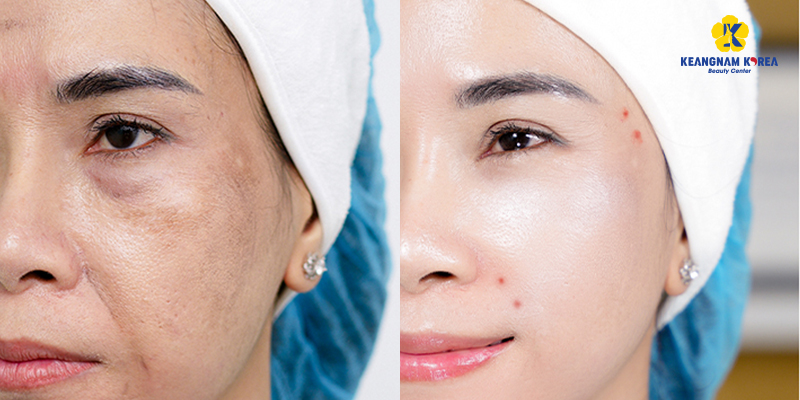
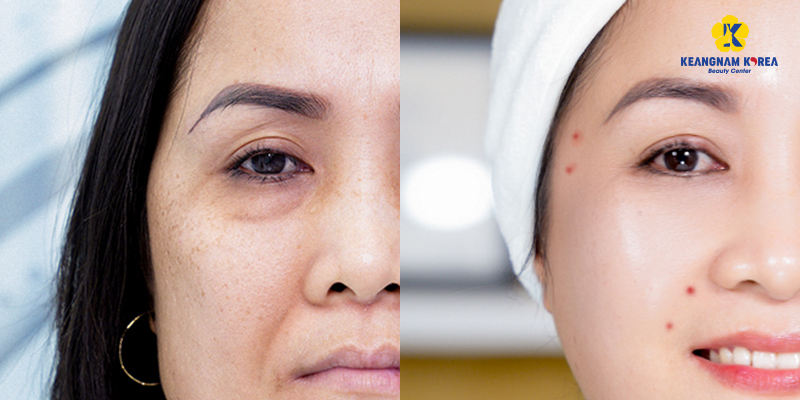
For clients whose temples show early aging but not true sagging, or who want to strengthen skin quality alongside a lift, Keangnam Korea also offers Reborn Cell Evolution X skin rejuvenation, its flagship non-surgical rejuvenation technology that stimulates the skin’s own collagen regeneration for firmer, denser skin over the whole upper face.
At consultation, the surgeon will tell you honestly which of the two your temples need, including the case where the answer is “neither, yet.”
To find out which stage your temples are actually in, book a free 1:1 consultation via hotline 0911 833 555.
Learn more at:
- AH Lifting Codes face lift & wrinkle removal at Keangnam Korea
- Reborn Cell Evolution X skin rejuvenation
How long do the results of a temple lift last?
A surgical temple lift with deep-layer fixation typically holds for 7–10 years, depending on your natural aging speed, sun exposure, and smoking. This is the key difference from a thread lift in the same area, which fades within 1–3 years as the threads dissolve.
Does a temporal lift hurt?
The procedure itself is painless because it is performed under local anesthesia with sedation. After the anesthetic wears off, most clients describe tightness rather than pain at the temples for 24–48 hours, controlled well with standard pain relief.
What is the best age for a temple lift?
Most clients are between 30 and 45, but the real criterion is tissue laxity, not your birthday. The procedure is indicated once the brow tail has genuinely dropped (Stage 2 above), whenever that happens for your face.
Can a temple lift be combined with eyelid surgery?
Yes, and the combination is common. Lifting the temple repositions the brow while double eyelid or upper-lid surgery refines the lid itself, done in one session with a single recovery period. Whether you need one or both depends on how much of the heaviness comes from the brow versus the lid, which the surgeon determines at examination.
Will the surgery raise my hairline?
With the incision placed behind the hairline and a conservative lift vector, any shift is a few millimeters and not noticeable. Significant hairline elevation is a sign of an over-aggressive skin-only technique, another reason the deep-layer endoscopic approach is worth its price.
RELATED ARTICLES

Collagen Injection vs. Laser for Facial Skin: Cost, Recovery, and Fit
A collagen injection vs laser for aging facial skin, which is better? They are two distinct approaches to facial rejuvenation and do not replace each other. Lasers work from the outside in to correct surface texture and pigment, while injected

Collagen Shots for the Face vs. Mesotherapy: Aging Grades, Cost, and Results
Deciding between collagen shots for the face and mesotherapy comes down to identifying which layer of your skin is experiencing aging. Mesotherapy nourishes the superficial skin layers for quick surface hydration, whereas collagen shots for the face rebuild structural density
How Long Does a Fox Eye Thread Lift Last? Costs, Risks, and Results
A fox eye thread lift is a minimally invasive procedure that uses dissolvable barbed threads to suspend the outer corner of the eye (lateral canthus) and the eyebrow tail toward the temple. By gently pulling these soft tissues upward, the

What Is a Liquid Nose Job? Cost, Longevity and When Do Threads Work Better?
What is a liquid nose job? A liquid nose job (clinically known as liquid rhinoplasty) is a non-surgical procedure that reshapes the nose using precision injections of hyaluronic acid (HA) filler. The treatment takes 10 to 15 minutes, requires zero

Semi-Structural Rhinoplasty for a Low Bridge and Wide Tip: Cost and Recovery
Semi-structural rhinoplasty is a targeted surgical procedure that reshapes specific portions of the nose, typically modifying a broad, rounded tip with autologous cartilage while elevating a slightly low bridge with a biocompatible implant. The procedure takes 45 to 90 minutes

Non-Surgical Rhinoplasty Price in 2026: Cost by Filler and Thread Type
The non-surgical rhinoplasty price in Ho Chi Minh City, Vietnam, ranges from $230 to $1,720 (6 to 45 million VND) per treatment in 2026. The overall cost is determined primarily by the specific material and technique selected: The material used