Skip to content


What Is Inner and Outer Corner Eye Surgery? Techniques, Costs, and Recovery
Inner and Outer Corner Eye Surgery are two distinct procedures. Inner corner eye surgery (epicanthoplasty) addresses the epicanthal fold to reduce intercanthal distance. Outer corner eye surgery (lateral canthoplasty) modifies the outer eye angle and tilt. In Ho Chi Minh City, single-corner procedures cost $150 to $840 (4 to 22 million VND), while combined dual-corner packages range from $210 to $950 (5.6 to 25 million VND).

What Are Epicanthal Folds and How Do They Affect the Inner Corner?
An epicanthal fold is a skin fold at the inner corner of the upper eyelid that extends downward toward the nose, covering the inner corner (medial canthus) of the eye. Present in almost all infants, this anatomical feature persists into adulthood in about 2% of non-Asian individuals and up to 90% of Asian adults.
An epicanthal fold changes the appearance of your eyes in two key ways:
- Conceals the inner corner: The fold covers the pink inner corner, making your horizontal eye opening look shorter than it really is.
- Creates wide-set spacing: It creates an optical illusion of wider-set eyes by increasing the visible skin gap between the two inner corners.
Approximately 50% of individuals of Asian descent do not have a natural upper eyelid crease. While surgeons often discuss epicanthal folds and eyelid creases in the same visit, epicanthal fold correction and double eyelid surgery are distinct procedures that can be performed independently.
How Does Inner Corner Eyelid Surgery Work?
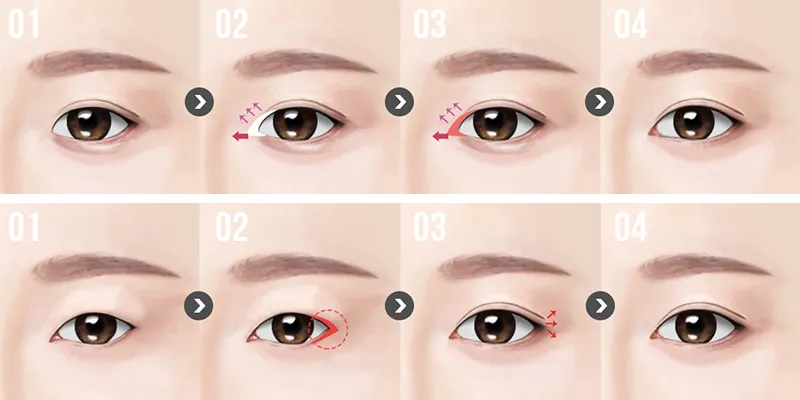
Inner corner eyelid surgery (Epicanthoplasty) releases or moves the skin of the epicanthal fold to reveal the underlying inner corner, extending your eye opening horizontally toward your nose. The technique alters the eye frame by precise margins measured in millimeters.
Intercanthal Distance Requirements
A primary measurement determines whether you are a suitable candidate before selecting a surgical technique. An intercanthal distance below 32 mm indicates that your inner corners are already close together. Releasing the inner fold in this scenario moves the corners even closer, which can disrupt your overall facial balance.
Scarring Considerations
Managing incision lines in the medial canthal area requires careful planning. Skin at the inner corner is thin and lacks natural folds to hide suture lines, making precise flap placement essential for smooth healing.
What Is Outer Eye Corner Lift and Lateral Eye Widening Surgery?
Outer eye corner lift and lateral eye widening surgery (lateral canthoplasty) adjust the outer boundary of your eye opening to change its tilt or widen its horizontal aperture. Surgeons operate within tight anatomical limits, usually restricting vertical adjustments to a maximum of 3 mm.
The Standard Canthal Tilt Baseline
An outer corner positioned about 1.2 mm higher than the inner corner, representing a slight upward angle of roughly 4.1 degrees, is widely recognized in surgical literature as the standard for aesthetic balance.
Two practical realities apply to outer corner procedures:
- Pre-existing angle limits benefit: An eye that already has a 1.2 mm upward tilt gains very little aesthetic benefit from further elevation.
- Anatomical boundaries prevent over-rotation: Structural tissue along the outer eye socket prevents extreme changes in eye angle.
Inner and Outer Corner Eye Surgery Comparison
Inner and outer corner eye surgery focus on different structures and rely on distinct diagnostic measurements. The table below compares the key features of both procedures.
| Feature / Metric | Inner Corner Surgery (Epicanthoplasty) | Outer Corner Surgery (Lateral Canthoplasty) |
| Primary Structure Treated | Epicanthal fold covering the inner corner | Outer eye tendon and lower/upper eyelid margin |
| Key Diagnostic Metric | Intercanthal distance (under 32 mm rules out surgery) | Canthal tilt (1.2 mm elevation above inner corner is balanced) |
| Direction of Change | Lengthens the eye opening horizontally toward the nose | Lengthens the eye toward the temple; lifts tilt by up to 3 mm |
| Facial Impact | Reduces the visual gap between wide-set eyes | Softens a downward outer tilt or widens narrow outer eyelids |
| Primary Scar Location | Incisions fall on the inner corner skin | Incisions hide in the outer lid crease; line may stay pink for 3 months |
| Price Range in Ho Chi Minh City | $150 – $840 (4 to 22 million VND) | $270 – $840 (7 to 22 million VND) |
What Are the Asian Epicanthoplasty Techniques?
Asian epicanthoplasty techniques are categorized by the geometry of the skin flaps used to reposition or release the inner fold. Standard technical approaches published in surgical literature include:
- The Y-W Epicanthoplasty: Uses Y-shaped incisions closed in a W-pattern to lengthen skin along the inner fold.
- The Skin-Redraping Technique: Reveals the inner corner by redraping skin flaps without removing underlying tissue.
- The VM-Plasty & U-Flap: Customized flap designs shaped to accommodate different fold severities.
When discussing flap options with your surgeon, focus on two key practical factors:
- Incision placement: Placing the final line within the natural fold of the corner helps conceal scarring better than placing it across flat skin.
- Tissue preservation: Techniques that redrape skin instead of cutting it away leave more tissue intact if you ever need a revision procedure.
Is There a Scarless Epicanthoplasty Procedure?
No epicanthoplasty procedure is completely scarless, as every surgical approach requires an incision through skin. Terms like “scarless epicanthoplasty” refer to flap designs designed to hide incision lines inside natural contours rather than the complete absence of a mark.
Key differences between surgical approaches include:
- Traditional Cutting Methods: Incisions are placed on flat medial skin, making early healing lines more noticeable.
- Skin-Redraping Methods: Incisions are hidden inside the natural fold of the inner corner to improve visual concealment.
Three main factors influence how your incision lines mature:
- Flap Design Placement: Hiding incisions along the inner junction of your eyelids improves concealment compared to flat skin placement.
- Individual Healing Response: Your personal tendency to form raised or thick scars plays a major role in line recovery.
- Sun Protection Habits: Shielding healing tissue from ultraviolet light during early recovery helps prevent dark skin discoloration.
How Much Does Corner Eye Surgery Cost in Ho Chi Minh City?
Corner eye surgery in Ho Chi Minh City ranges from $150 to $990 (4 to 26 million VND) in 2026, depending on procedural complexity and whether corner work is combined with eyelid crease surgery.

Epicanthoplasty Cost and Medial Canthoplasty Cost
Inner corner procedures cost between $150 and $840 (4 to 22 million VND). Simple fold releases sit at the lower end of this range, while complex flap re-anchoring or secondary repairs reach higher tiers, starting from $300 (8 million VND) for corrective revision work.
Lateral Canthoplasty Cost
Outer corner surgery ranges from $270 to $840 (7 to 22 million VND), with most primary quotes falling between $300 and $460. Complex flap transfers like W-plasty or Z-plasty represent the upper price tier.
Which Corner Surgery Suits Your Eye Shape?
- Points to Inner Corner Surgery: A prominent epicanthal fold covering your inner corner, paired with an intercanthal distance well above 32 mm.
- Points to Outer Corner Surgery: An outer corner that sits level with or lower than your inner corner on an otherwise clear eyelid margin.
- Points to Combined Corner Surgery: Wide-set eyes accompanied by a downward outer tilt, where single-corner adjustment leaves the overall frame unbalanced.
- Points to Leave Corners Alone: Eyes displaying a balanced 1.2 mm positive tilt and standard intercanthal spacing, or cases where heavy upper lid skin is the primary concern.
Note: Plan a stay of 10 to 14 days in Ho Chi Minh City to complete your consultation, procedure, suture removal, and final follow-up check before flying home.
Related Reading
- What the inner corner scar looks like as it fades
- Correcting a downward outer corner
- Eyelid surgery options in Ho Chi Minh City
- Understanding Lateral Canthoplasty vs. Canthopexy Differences
- Outer Corner Eye Surgery: Techniques and Structural Adjustments
Outer and Inner Corner Eyelid Surgery at Keangnam Korea
Choosing the right surgical partner ensures your corner surgery is guided by objective anatomical measurements rather than guesswork. Keangnam Korea combines Advanced 3D AI Simulation with clinical precision to customize inner corner, outer corner, or combined procedures specifically for your face.
Key clinical standards at Keangnam Korea include:
- Advanced 3D Facial Simulation: Preview your projected eye shape directly on screen to confidently decide between inner, outer, or combined corner surgery.
- Objective Baseline Measurements: Your exact intercanthal distance and canthal tilt are measured in millimeters before booking, giving you a clear benchmark for evaluation.
- Hospital-Grade Sterile Environment: Every procedure is performed in a sterile operating room using strict infection control protocols.
- Single-Surgeon Continuity: The specialist who evaluates your eyes during your consultation is the same doctor who performs your surgery.
- Dedicated International Support: Native English-speaking coordinators assist you through consultation, surgery, and follow-up, ensuring your travel itinerary aligns with your recovery timeline.

Schedule an examination at Keangnam Korea today to view your personalized corner simulation and receive a written surgical proposal.
RELATED ARTICLES

Collagen Injection vs. Laser for Facial Skin: Cost, Recovery, and Fit
A collagen injection vs laser for aging facial skin, which is better? They are two distinct approaches to facial rejuvenation and do not replace each other. Lasers work from the outside in to correct surface texture and pigment, while injected

Collagen Shots for the Face vs. Mesotherapy: Aging Grades, Cost, and Results
Deciding between collagen shots for the face and mesotherapy comes down to identifying which layer of your skin is experiencing aging. Mesotherapy nourishes the superficial skin layers for quick surface hydration, whereas collagen shots for the face rebuild structural density
How Long Does a Fox Eye Thread Lift Last? Costs, Risks, and Results
A fox eye thread lift is a minimally invasive procedure that uses dissolvable barbed threads to suspend the outer corner of the eye (lateral canthus) and the eyebrow tail toward the temple. By gently pulling these soft tissues upward, the

What Is a Liquid Nose Job? Cost, Longevity and When Do Threads Work Better?
What is a liquid nose job? A liquid nose job (clinically known as liquid rhinoplasty) is a non-surgical procedure that reshapes the nose using precision injections of hyaluronic acid (HA) filler. The treatment takes 10 to 15 minutes, requires zero

Semi-Structural Rhinoplasty for a Low Bridge and Wide Tip: Cost and Recovery
Semi-structural rhinoplasty is a targeted surgical procedure that reshapes specific portions of the nose, typically modifying a broad, rounded tip with autologous cartilage while elevating a slightly low bridge with a biocompatible implant. The procedure takes 45 to 90 minutes

Non-Surgical Rhinoplasty Price in 2026: Cost by Filler and Thread Type
The non-surgical rhinoplasty price in Ho Chi Minh City, Vietnam, ranges from $230 to $1,720 (6 to 45 million VND) per treatment in 2026. The overall cost is determined primarily by the specific material and technique selected: The material used