Skip to content


What Can Nose Reshaping Change About Your Nose Shape?
Nose reshaping can alter five key anatomical areas: the bridge height, tip projection and angle, nostril width, dorsal humps or deviations, and overall structural symmetry. By modifying these areas, a surgeon can craft distinct facial profiles, such as a soft S-line, a sharp L-line, a natural refinement, or a feng shui aligned shape.
While a permanent plastic surgery nose job restructures underlying bone and cartilage, nose reshaping without surgery uses temporary fillers or threads to smooth out minor contour imbalances.

The Four Nose Shapes Requested Most in Ho Chi Minh City
- S-Line Profile: Features a soft, elegant curve flowing smoothly from the bridge down to a slightly elevated tip. This outline is most frequently requested by candidates seeking a gentle, harmonious, and feminine look.
- L-Line Profile: Features a high, straight bridge that transitions into a sharp, defined tip, mimicking a striking Western profile. This shape reads as stronger and more structured, making it popular among men and clients wanting sharp facial definition via nose bridge surgery.
- Natural Refinement: Focuses strictly on correcting the single weakest feature (such as a slight bump or wide nostril) while leaving the rest of the nose untouched. The overall face retains its native character, leaving no obvious signs of a plastic surgery nose job.
- Feng Shui Shape: Characterized by a straight bridge, a moderately full tip, and slim alae, designed to align with traditional Asian face-reading concepts for good fortune. While requested by name for its symbolic value, the physical surgical steps behind it are identical to standard structural procedures.
What Decides the Nose Shape You Can Get?
Skin thickness, septal length, tip cartilage strength, and the width of the nasal bones set the limit on any shape. A thorough clinical examination measures all four variables is a must to plan for your plastic surgery nose job.
- Thin skin: Thin nasal skin limits how high a synthetic implant can go, because the outline shows through as a shiny red line and the tip skin can thin further over the implant. Most people in this group do better with their own cartilage carrying the height, or with a dermofat graft at $570 to $1,260 (15 to 33 million VND).
- A short septum: A nose that is short and turned up needs the septum lengthened before the tip can be rotated down. That single finding moves a case from a bridge implant to structural work, and roughly doubles the quote.
- Weak tip cartilage: A wide or drooping tip does not hold a sharper outline on its own, so a graft of ear cartilage is added to support it.
- Wide nasal bones: A broad bony base keeps a nose looking wide even after the bridge is raised, so filing the hump and narrowing both sidewalls belong in the same operation.
Material choice follows from those four findings. Synthetic bars shape quickly, cost less, and heal early, which suits clients on a short schedule. Cartilage taken from the ear, septum, rib, or temporalis fascia is preferred when compatibility matters most, and for thin skin or a history of trouble with a synthetic bar.
Nose Reshaping Without Surgery
Non-surgical rhinoplasty offers a fast way to elevate the bridge and smooth out minor contour steps without an incision. The overall nose reshaping cost for non-surgical options ranges from $230 to $1,710 USD (6 to 45 million VND), with results lasting anywhere from 6 to 24 months depending on the material used.
However, nose reshaping without surgery has structural limits: it cannot narrow a wide nasal base, rotate a drooping tip downward or upward, or shorten an elongated nose.
1. Hyaluronic Acid (HA) Nose Fillers
Injectable fillers add volume along the nasal bridge in a quick 10-to-15-minute session, delivering immediate visual results that last 12 to 18 months for $230 to $760 USD (6 to 20 million VND).
- Limitations & Migration: Over repeated sessions, filler material tends to spread sideways at the root of the nose, potentially widening the space between the eyes rather than creating sharp definition.
- The Reversibility Advantage: Unlike any surgical alternative, HA filler offers an immediate exit route. If you dislike the result, a doctor can inject Hyaluronidase, an enzyme that safely breaks down hyaluronic acid, to dissolve the filler within 24 to 48 hours.
2. Bio-Thread Nose Lifts
A thread lift uses absorbable, barbed threads (PDO, PLLA, or PCL) inserted along the bridge to create tension and elevation. The procedure takes 20 to 30 minutes, requires 1 to 3 days of recovery, and maintains its lift for 6 to 12 months at a price of $270 to $1,710 USD (7 to 45 million VND).
- Removal Challenges: Unlike fillers, thread lifts cannot be easily reversed. The microscopic barbs anchor tightly into native tissue; removing a misplaced thread requires an open surgical dissection that leaves firm scar tissue behind.
Nose Reshaping Surgery
Nose reshaping surgery provides long-term structural stability lasting 10 to 25+ years, compared to just 6 to 24 months for non-surgical alternatives. While the total nose reshaping cost ranges from $760 to $8,370 USD (20 to 220 million VND), the primary trade-off is recovery time: requiring 7 to 20 days of downtime instead of 1 to 3 days for fillers or threads.
Three surgical techniques cover the vast majority of individual needs in Ho Chi Minh City:
1. Cartilage-Wrapped Bridge and Tip
This technique combines a pre-carved synthetic implant to elevate the bridge with a protective layer of autologous ear cartilage or temporalis fascia over the tip. Surgery takes 45 to 60 minutes, with a recovery timeline of 7 to 10 days and results lasting 15 to 20 years for $760 to $1,050 USD (20 to 27.5 million VND).
- Skin Protection: Wrapping the tip with biological tissue prevents the synthetic implant edge from thinning or reddening thin nasal skin over time.
- Graft Absorption Rate: Approximately 5% to 10% of the grafted cartilage is absorbed during the first 1 to 2 years, while the remainder integrates into a permanent protective pad.
- Anatomical Limit: This procedure leaves the septum untouched, meaning it cannot lengthen a short or upturned nose.
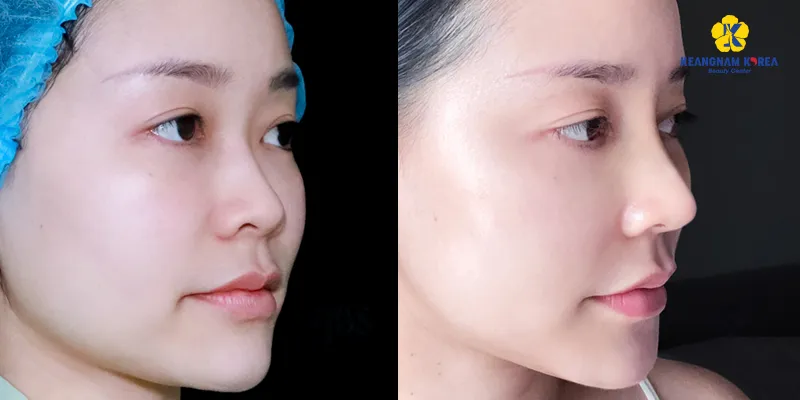
Ideal Candidates & Travel Requirements:
- Best suited for: First-time customers with normal to thin skin who only need bridge elevation and minor tip protection, without needing septum extension.
- Minimum Stay in Vietnam: 7 to 10 days. (Includes initial consultation, surgery, splint/stitch removal on day 7, and a final clearance check before flying).
2. Structural Reshaping With ePTFE
An open-approach nose reshaping surgery that reconstructs the columella, the narrow tissue strip between the nostrils, using septal or costal cartilage struts. Bridge elevation is achieved using microporous ePTFE implants (such as Surgiform or Nanoform), while ear cartilage refines the tip. Surgery takes 60 to 120 minutes, requires 10 to 15 days of recovery, and fully stabilizes over 3 to 6 months for $1,140 to $2,930 USD (30 to 77 million VND).
- Biocompatible Tissue Integration: Millions of microscopic pores in ePTFE allow native tissue and micro-vessels to grow into the implant, anchoring the bridge firmly in place.
- Versatile Solution: Ideal for complex cases, including short, upturned, bulbous, humped, or deviated noses, as well as correcting failed previous surgeries.

Ideal Candidates & Travel Requirements:
- Best suited for: Individuals needing structural changes (lengthening a short nose, correcting asymmetry, or repairing minor past surgical failures) who prefer stable synthetic bridge implants combined with autologous cartilage.
- Minimum Stay in Vietnam: 10 to 12 days. (Allows time for post-op swelling management, internal splint removal on day 3–5, external suture removal on day 7–10, and a follow-up assessment).
3. Autologous Rib Cartilage Rebuild
As the most comprehensive plastic surgery nose job option, this procedure harvests a 2 to 3 cm segment of the customert’s 6th or 7th rib to reconstruct the columella, septum, and bridge entirely from natural body tissue. Performed under general anesthesia in an accredited hospital, surgery takes 120 to 180 minutes, with 15 to 20 days of recovery for $3,040 to $8,370 USD (80 to 220 million VND).
- Zero Rejection Risk: Using 100% autologous rib cartilage eliminates foreign material rejection, making it the gold standard for severely damaged, infected, or contracted noses.
- Trade-Offs & Warping Risks: Involves a secondary donor site wound beneath the breast and carries a 2% to 5% risk of slight cartilage warping or partial absorption during initial healing.
Ideal Candidates & Travel Requirements:
- Best suited for: People with severely damaged/contracted noses from multiple failed surgeries, severe infections, or known allergies to synthetic materials.
- Minimum Stay in Vietnam: up to 20 days. (Requires hospital admission for 24–48 hours, chest donor-site monitoring, stitch removal at two separate sites, and mandatory follow-ups before long-haul flights).

Risks and Side Effects of Each Type of Nose Job
Every route carries side effects, and they differ enough that the choice of technique is also a choice of which risk to accept:
- Filler: Vascular occlusion is the serious one, with vision loss and tissue death both reported by the Food and Drug Administration. Spreading at the root over repeat sessions is the common one.
- Bio-threads: Infection, a thread working its way to the surface, and a pulled septum are the reported problems, and a thread that has bound into tissue does not come out easily.
- Synthetic bar: Redness and a visible outline through thin skin, downward slipping, and breakdown of the tip skin. A cartilage wrap lowers all three.
- Structural work and rib cartilage: Swelling that takes three to six months to settle fully, a 2 to 5% rate of warping in carved rib cartilage, and a chest wound that adds its own healing time.
Swelling and bruising follow every surgical route, and the tip is the slowest area to soften. Judging an outcome at week two is judging swelling, not shape.
→ Learn more: Swelling and aftercare in the first weeks
Nose Bridge Surgery Cost by Implant Material in Vietnam
The nose bridge surgery cost in Ho Chi Minh City, Vietnam ranges from $530 to $850 USD (14 to 22.4 million VND) when a standalone synthetic implant is used to elevate the bridge. The procedure takes 15 to 30 minutes via a hidden endonasal incision inside one nostril, with suture removal scheduled between days 5 and 7. Standard synthetic implants generally maintain their shape for 10 to 25 years before revision or structural reconstruction is recommended.
Clinics in Vietnam offer five main implant materials:
- Soft Silicone & Softxil: Softxil and medical-grade silicone are the standard choices for basic bridge elevation. They are easy to sculpt, highly affordable, and quick to place beneath the skin framework.
- Gore-Tex, Surgiform & Nanoform (ePTFE): Advanced microporous materials like Surgiform and Nanoform are quoted as part of comprehensive structural packages ranging from $1,830 to $2,850 USD (48 to 75 million VND). These packages cover bone filing, septal extension, and tip reshaping alongside the implant placement.
Risks & Protective Measures for Standalone Implants
While a standalone synthetic implant is the least invasive surgical route, it carries distinct aesthetic and structural risks over time:
- Implant Migration & Redness: Placing a high synthetic bar under thin skin can cause visible skin thinning, persistent redness at the tip, or downward sliding of the implant. In rare instances, excessive pressure can lead to skin erosion.
- Cartilage Shielding: To mitigate these risks, surgeons frequently recommend adding a cartilage wrap (harvested from the ear or fascia) for an additional $230 USD (6 million VND). This extra layer acts as a natural buffer, shielding thin skin from the hard synthetic edge.
Ideal Candidates & Travel Requirements:
- Best suited for: Peole with thick soft tissue, adequate natural nose length, and a well-defined tip who only need vertical height enhancement along the bridge.
- Minimum Stay in Vietnam: 7 days. (Allows for initial consultation, quick surgery, follow-up monitoring, and suture removal before flying home).
2026 Nose Surgery Costs in Ho Chi Minh City by Procedure Type
Choosing the right rhinoplasty procedure in Ho Chi Minh City depends on your specific aesthetic goals, anatomical needs, and travel timeline. In 2026, clinic pricing across HCMC centers around nine distinct shape goals, ranging from subtle non-surgical tweaks to complex structural reconstructions. Each approach carries its own recovery window, procedural complexity, and price tag.
| Shape goal | Route | Recovery | Cost in 2026 |
| Raise the bridge with a same-day result | Hyaluronic acid filler | Same day | $230–$760 |
| Raise the bridge, avoid an operation | Bio-threads | 1–3 days | $270–$1,710 |
| Raise the bridge and keep it for years | Soft silicone or Softxil bar | 5–7 days | $530–$850 |
| Raise the bridge and protect the tip | Bar plus a cartilage wrap | 7–10 days | $760–$1,050 |
| Narrow or lift a wide tip | Ear cartilage tip graft | 7–10 days | $380–$1,520 |
| Narrow a wide nostril base | Alar base reduction | 5–7 days | $190–$570 |
| Remove a hump or straighten a bend | Bone filing and septal correction | 10–15 days | $380–$840 |
| Change the whole outline | Structural work with ePTFE | 10–15 days | $1,140–$2,930 |
| Rebuild after a failed operation | Rib cartilage reconstruction | 15–20 days | $3,040–$8,370 |
→ Learn more: 5 types of nose job in Vietnam
Nose Surgery Consultations at Keangnam Korea
Located in Ho Chi Minh City, Keangnam Korea Beauty Center specializes in personalized nose reshaping solutions tailored to your unique facial features and travel itinerary. Rather than pushing pre-set surgical packages, our board-certified surgeons evaluate your natural anatomy first, ensuring the shape you desire is one your nose can safely support long after you return home.
When you book your rhinoplasty journey with us, you benefit from our uncompromised international standards:
- 100% Surgical Continuity: The specialist who evaluates your nasal structure during your initial consultation is the exact plastic surgeon who conducts your operation.
- Hospital-Grade Sterilization: Every plastic surgery nose job is performed in a state-of-the-art sterile operating theater featuring a one-way workflow to minimize post-operative infection risks.
- VIP Private Care: Enjoy ultimate comfort and privacy with individual recovery suites assigned to you from your initial visit through final discharge.
- Dedicated English Medical Coordinator: A personal bilingual assistant accompanies international patients through every step—ensuring clear communication of all procedures, consent forms, and recovery protocols.
- Post-Fly Care Support: Your surgical itinerary is customized around your remaining days in Vietnam, with a 24/7 direct follow-up channel remaining active long after you fly back home.
→ Learn more: Nose reshaping at Keangnam Korea

Get Your Virtual Assessment Today
Planning your cosmetic trip to Ho Chi Minh City is simple. Before traveling, receive a personalized preliminary treatment plan and estimated types of nose surgery cost right from home:
- Send Us Your Photos: Submit clear high-resolution photographs of your face (front view, side profile, and basal view from below).
- Share Your Goals & Timeline: Tell us your desired profile outline (such as S-line or L-line) and the exact number of days you plan to stay in Vietnam.
- Receive Your Medical Plan: Our plastic surgery team will evaluate your photos and send back a written preliminary treatment strategy, recommended techniques, and a transparent price quote.
Ready to begin? Contact Keangnam Korea today to schedule your consultation and secure your preferred travel dates!
How much does nose reshaping cost in Ho Chi Minh City?
Nose reshaping cost falls into three bands. Filler or threads cost $230 to $1,710 (6 to 45 million VND), implant work on the bridge costs $530 to $1,050 (14 to 27.5 million VND), and structural or rib cartilage rebuilding costs $1,140 to $8,370 (30 to 220 million VND). Skin thickness and septal length decide which band applies.
Can nose filler be dissolved if the shape is wrong?
Yes. Hyaluronidase breaks down hyaluronic acid filler within 24 to 48 hours and the nose returns to its earlier outline. Bio-threads do not come out the same way, since the barbs bind into tissue and removal means an open dissection that leaves firm scar tissue behind.
How long before the final nose shape settles?
Sutures come out between day five and day 10 depending on the technique, and the shape stabilizes over three to six months after structural work. Filler shows its outline the same day. Judging a surgical result before month three is early, since the tip is the slowest part to soften.
Is an S-line or an L-line shape better for a Western face?
An L-line suits a face that already carries height, since it keeps the bridge straight and finishes the tip sharp. An S-line adds a soft curve that reads as gentler and is asked for more often across Asia. Skin thickness matters more than either name, because thin skin shows an implant outline.
How many days in Ho Chi Minh City does a nose operation need?
Filler and threads need one to three days. A bar with a cartilage wrap needs seven to 10 days before review, structural work needs 10 to 15, and rib cartilage reconstruction needs 15 to 20. Add two days at the front for the examination and the shape discussion.
RELATED ARTICLES

Collagen Injection vs. Laser for Facial Skin: Cost, Recovery, and Fit
A collagen injection vs laser for aging facial skin, which is better? They are two distinct approaches to facial rejuvenation and do not replace each other. Lasers work from the outside in to correct surface texture and pigment, while injected

Collagen Shots for the Face vs. Mesotherapy: Aging Grades, Cost, and Results
Deciding between collagen shots for the face and mesotherapy comes down to identifying which layer of your skin is experiencing aging. Mesotherapy nourishes the superficial skin layers for quick surface hydration, whereas collagen shots for the face rebuild structural density

How Long Does a Fox Eye Thread Lift Last? Costs, Risks, and Results
A fox eye thread lift is a minimally invasive procedure that uses dissolvable barbed threads to suspend the outer corner of the eye (lateral canthus) and the eyebrow tail toward the temple. By gently pulling these soft tissues upward, the

What Is a Liquid Nose Job? Cost, Longevity and When Do Threads Work Better?
What is a liquid nose job? A liquid nose job (clinically known as liquid rhinoplasty) is a non-surgical procedure that reshapes the nose using precision injections of hyaluronic acid (HA) filler. The treatment takes 10 to 15 minutes, requires zero

Semi-Structural Rhinoplasty for a Low Bridge and Wide Tip: Cost and Recovery
Semi-structural rhinoplasty is a targeted surgical procedure that reshapes specific portions of the nose, typically modifying a broad, rounded tip with autologous cartilage while elevating a slightly low bridge with a biocompatible implant. The procedure takes 45 to 90 minutes

Non-Surgical Rhinoplasty Price in 2026: Cost by Filler and Thread Type
The non-surgical rhinoplasty price in Ho Chi Minh City, Vietnam, ranges from $230 to $1,720 (6 to 45 million VND) per treatment in 2026. The overall cost is determined primarily by the specific material and technique selected: The material used