Skip to content


How Much Is Rhinoplasty in Vietnam? 2026 Prices & Stay Duration
In 2026, rhinoplasty in Vietnam costs between $230 and $8,360 USD (6 million to 220 million VND), with final pricing determined by structural complexity, graft materials, and surgical technique: non-surgical liquid or thread nose reshaping ($230–$1,710 / 6M–45M VND), silicone implant bridge augmentation ($530–$1,050 / 14M–27.5M VND), structural bridge and tip reconstruction ($1,140–$2,930 / 30M–77M VND), and autologous rib cartilage reconstruction ($3,040–$8,360 / 80M–220M VND).
Your available travel window dictates which procedure is feasible, as required post-operative recovery stays in Vietnam range from same-day departures up to 20 days for complex rib cartilage cases. Below is a breakdown of what each technique corrects, updated 2026 pricing in Ho Chi Minh City, and essential criteria to verify hospital licensing before booking your flight.

Planning a Nose Job in Vietnam Around Your Travel Dates
Planning rhinoplasty in Vietnam requires a stay duration ranging from 1 day to 3 weeks, dictated entirely by the underlying surgical technique. Surgical procedures necessitate keeping customers local until skin sutures and nasal splints are removed on days 5 to 7, followed by a mandatory post-operative checkup before long-haul flights are medically cleared.
Match your available travel window to the appropriate procedure tier:
- Under 1 Week Stay (Non-Surgical Reshaping): Restricted strictly to hyaluronic acid dermal fillers (immediate recovery) or absorbable bio-thread lifting (1 to 3 days downtime). These options involve no surgical incisions, requiring no post-op wound evaluation before flying. Surgical rhinoplasty is strictly contraindicated for trips under 7 days.
- 10 Days to 2 Weeks Stay (Implant & Tip Refinement): Accommodates silicone/Gore-Tex bridge augmentation (8 to 10 days visible recovery), ear cartilage tip grafting (7 to 10 days), and alar base reduction / nostril narrowing (5 to 7 days). Plan for 2 to 3 buffer days upfront for initial consultation, 3D imaging, and pre-operative blood panels.
- 3 Weeks or More Stay (Structural & Rib Reconstruction): Required for complex autologous rib cartilage reconstruction (15 to 20 days healing window) and secondary revision rhinoplasty (10 to 15 days healing). Revision cases demand extended stays because scar tissue release and previous implant removal cannot be scheduled until full tissue dissection occurs.
- Local Residents & Long-Term Expats: Unlimited timeline flexibility allows for staged surgical protocols (e.g., executing a secondary tip refinement 3 to 6 months after initial bridge placement) without incurring extra travel or hotel expenses.
Tip: Never book non-refundable return flights before your initial clinical assessment. Finalize your travel departure only after your surgeon approves your personalized recovery protocol.
5 Types of Rhinoplasty Procedures in Vietnam
Cosmetic rhinoplasty in Ho Chi Minh City encompasses five primary surgical and non-surgical modalities. Rather than offering varying degrees of the same result, each technique addresses distinct anatomical structures, structural deficits, and skin characteristics.
1. Dermal Fillers & Bio-Thread Lifts (Non-Surgical Reshaping)
Non-surgical augmentation offers immediate, low-downtime shape refinement without structural surgical intervention:
- Hyaluronic Acid (HA) Dermal Fillers: Injected in 10 to 15 minutes to increase nasal bridge height and smooth minor dorsal humps, with results lasting 12 to 18 months.
- Absorbable Bio-Thread Lifts (PDO, PLLA, PCL): Inserted through micro-entry points in 20 to 30 minutes to elevate the bridge and refine the nasal tip. Depending on polymer degradation rates, retention spans 6 to 12 months for Polydioxanone (PDO), 12 to 18 months for Poly-L-Lactic Acid (PLLA), and up to 24 months for Polycaprolactone (PCL).
2. Synthetic Bridge Rhinoplasty
Synthetic bridge augmentation is a closed-incision surgical procedure designed solely to increase nasal bridge height. Utilizing pre-shaped medical-grade silicone or biocompatible Softxil (silicone wrapped in expanded PTFE/ePTFE) implants, the surgeon inserts the material through an intranasal incision inside one nostril.
The procedure takes 15 to 30 minutes and involves zero disruption to the nasal septum, tip cartilage, or nasal bones, making it the fastest surgical rhinoplasty to perform and heal in Vietnam.
Implant-only augmentation is strictly indicated for individuals with:
- Adequate baseline nasal length and a structurally stable columella.
- A naturally well-defined, slim nasal tip requiring no projection or rotation.
- Moderate-to-thick dorsal skin cover capable of concealing synthetic material.
While synthetic implants offer a cost-effective, low-downtime solution, they carry specific anatomical constraints and longevity considerations:
- Prosthetic Longevity: Unlike autologous tissue reconstruction, synthetic implants typically hold an operational lifespan of 10 to 25 years rather than serving as a permanent lifelong graft.
- Thin Skin & Extrusion Risks: In cases with thin dorsal skin or short nasal structures, placing a synthetic implant down to the tip creates continuous mechanical pressure. Over time, this leads to implant displacement, tip erythema (redness), tissue thinning, and potential implant extrusion.
- No Structural Correction: Synthetic implants cannot lengthen a short nose, refine a bulbous tip, or correct structural septal deviations.

3. Cartilage Tip Graft
Composite augmentation combines a synthetic bridge implant (silicone or Softxil) with an autologous ear cartilage tip graft. Performed in 45 to 60 minutes, the surgeon harvests cartilage from behind the ear pinna and constructs a protective cap over the nasal tip. This biological buffer acts as a barrier between the synthetic implant tip and the overlying dermal layer, preventing long-term skin thinning and implant visibility.
Cartilage Resorption & Longevity Profiles
- Graft Absorption Rate: Approximately 5% to 10% of the autologous ear cartilage naturally resorbs within the first 1 to 2 years post-surgery. The remaining 90%+ integrates with local soft tissue, firming into a permanent biological barrier.
- Clinical Lifespan: Offers enhanced long-term stability (15 to 20+ years) compared to unbuffered, bare silicone implants.
While ear cartilage grafting significantly reduces mechanical pressure on thin tip skin, you must consider specific procedural factors:
- Secondary Donor Site: Requires an additional incision behind the ear cartilage bowl, adding localized donor-site tenderness and extending visible post-operative recovery by 3 extra days.
- Structural Limitations: Conchal cartilage is naturally curved and elastic, providing soft tissue cushioning rather than rigid mechanical support. It cannot extend or project a severely short nose or correct an underdeveloped, weak nasal septum, the issues that require structural septal extension grafting.
4. Structural Rhinoplasty
Full structural rhinoplasty utilizes an open trans-columellar incision to fully expose the internal osseocartilaginous framework. Performed under general anesthesia in 60 to 120 minutes, the surgeon constructs a rigid structural support strut (using septal cartilage or biocompatible donor matrix), elevates the bridge with microporous ePTFE implants (Surgiform or Nanoform), and precisely reshapes the nasal tip using autologous ear cartilage grafts.
Unlike superficial implant placement, structural rhinoplasty completely reshapes and reinforces the underlying framework, making it the definitive procedure for complex anatomical corrections:
- Short Nose & Tip Ptosis: Lengthens a severely short, upturned nose via septal extension grafting (SEG).
- Bulbous Tip & Asymmetry: Refines bulbous or boxy tips through lower lateral cartilage (LLC) reshaping and cephalic trim.
- Dorsal Hump & Septal Deviation: Reduces bony/cartilaginous humps and straightens a deviated nasal septum to improve both aesthetics and airway function.
Longevity & Recovery Trade-offs
- Permanent Results: Provides a lifelong structural foundation with no scheduled replacement cycle or expiration date.
- Extended Downtime & Investment: Requires approximately double the recovery period of simple implant placement (10 to 14 days of visible healing) and carries a financial cost 3 to 4 times higher than basic synthetic bridge augmentation.
Structural rhinoplasty is an architectural overhaul rather than a simple cosmetic overlay. By anchoring the new contours directly to the facial skeleton, it ensures permanent structural integrity without risking skin erosion or long-term tip droop.
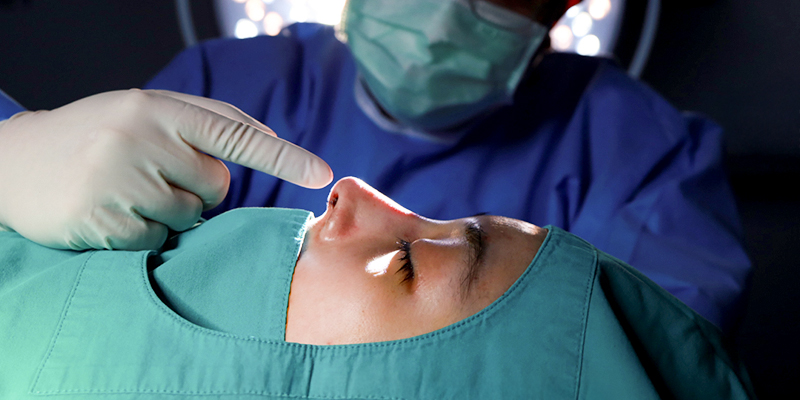
5. Autologous Rib Cartilage Rhinoplasty
Autologous rib cartilage reconstruction is the most advanced tier of structural nose surgery, utilizing a 2 to 3 centimeter segment of your own 6th or 7th costal cartilage to rebuild the nasal strut, septum, and dorsal bridge. Performed under general anesthesia in 120 to 180 minutes, this procedure places zero synthetic materials into the nose, eliminating the risk of prosthetic rejection or long-term biocompatibility issues.
Costal cartilage harvesting provides an abundant, exceptionally rigid source of donor tissue. Surgeons reserve this major reconstructive technique for complex clinical scenarios:
- Severe Scar Contracture: Noses shortened or deformed by severe internal scar tissue from multiple past procedures.
- Secondary & Complex Revisions: Individuals lacking usable ear or septal cartilage due to previous donor site depletion.
- Foreign-Body Reactions: Individuals who have experienced synthetic implant rejection, recurrent infection, or tissue necrosis from silicone or ePTFE.
- Major Structural Trauma: Complete collapse of the nasal bridge or septum requiring extensive skeletal framework restoration.
Clinical Longevity & Surgical Trade-offs
- Permanent Lifelong Graft: Provides a permanent structural foundation with no scheduled replacement timeline.
- Donor-Site & Anesthetic Scope: Requires a full hospital operating facility with emergency care infrastructure, adding a 2 to 3 cm donor-site incision along the submammary fold and prolonged recovery time.
Note: Autologous rib cartilage rhinoplasty requires a minimum of 15 to 20 days of local recovery stay in Vietnam before long-haul flight clearance, alongside physical activity restrictions to allow the chest wall incision to heal properly.
How Much Does Rhinoplasty in Vietnam Cost?
Rhinoplasty Vietnam cost starts at $190 for alar base reduction and reaches $8,360 for a rib cartilage rebuild:
| Procedure | Cost in HCMC |
| Nose filler | $230–$760 |
| Bio-thread lift | $270–$1,710 |
| Alar base reduction | $190–$570 |
| Hump, deviation, or saddle correction | $380–$840 |
| Tip reduction | $380–$1,520 |
| Synthetic implant | $530–$850 |
| Cartilage tip graft | $760–$1,050 |
| Dermofat graft to the nose | $570–$1,250 |
| Structural, Surgiform or Nanoform | $1,140–$2,930 |
| Rib cartilage reconstruction | $3,040–$8,360 |
| Implant removal and treatment of an inflamed nose | $300–$840 |
| Full reconstruction of a damaged nose | $1,520–$4,560 |

Is Rhinoplasty in Vietnam Cheaper Than Korea or Thailand?
Yes for every technique below, though the margin narrows as the operation gets bigger. A bridge and tip rebuilt together costs $1,140 to $2,930 in HCMC against $2,020 to $2,690 in Korea and $2,900 to $4,000 in Thailand.
| Operation | HCMC, 2026 | Korea, 2026 | Thailand, 2026 |
| Bridge raised with an implant | $530–$850 | $670–$1,350 | $1,100–$2,300 |
| Bridge and tip rebuilt together | $1,140–$2,930 | $2,020–$2,690 | $2,900–$4,000 |
| Revision after an earlier operation | $1,520–$4,560 | $3,370–$5,390 | $2,600–$4,900 |
Rib cartilage reconstruction is the exception. It costs $3,040 to $8,360 in HCMC against $3,030 to $4,710 in Korea, so the top of the Vietnamese range passes the Korean one. That operation is priced by theater time, anesthesia, and hospital capacity in every market, and those inputs cost roughly the same everywhere.
Flights and accommodation close some of the gap on the smaller operations. A serviced apartment in HCMC starts around $17 per night and a five-star room in District 1 runs $180 to $450. Over 12 nights, that gap is wider than the price difference on an implant case.
Who Should Postpone Rhinoplasty in Vietnam for a Longer Trip?
Rhinoplasty is an invasive architectural restructuring that should never be rushed to fit a tight vacation window. In clinical practice, an ethical plastic surgeon will advise postponing your procedure to a future trip if your travel itinerary or medical profile introduces unacceptable post-operative risks.
Postpone your surgical booking if your situation matches any of the four travel and clinical scenarios below:
1. Travel & Timeline Red Flags
- Fewer Than 10 Days Remaining in Vietnam: Sutures and nasal splints must remain intact until days 5 to 7, followed by a mandatory post-op clinical evaluation. Boarding a long-haul flight earlier subjects fresh micro-incisions to severe cabin pressure fluctuations and dry aircraft air, significantly raising the risk of acute hematoma, delayed wound healing, and wound dehiscence.
- Structural Reconstruction Required (Under 14 Days Stay): Structural nose jobs demand 10 to 15 days of localized recovery prior to initial review, while autologous rib cartilage reconstruction requires 15 to 20 days. A 2-week trip is clinically insufficient.
- Secondary Revision Rhinoplasty (Under 3 Weeks Stay): Revision cases require a minimum of 3 full weeks local stay. The surgeon must carefully excise previous scar tissue, remove legacy implant materials, and allow underlying soft tissue inflammation to subside before executing the structural rebuild.
- Zero Financial Buffer for Potential Complications: If your budget strictly covers surgery with no reserve, wait. Correcting a post-operative complication or secondary displacement costs an additional $1,520 to $4,560 USD, excluding emergency airfares and unpaid leave.
2. Medical Contraindications & Pre-Operative Screening
Written medical clearance from your primary physician must be secured before purchasing flights if you present with any of the following medical variables:
- Pharmacological & Systemic Factors: Active use of anticoagulants, antiplatelets, or immunosuppressants; uncontrolled diabetes mellitus; or known coagulopathies (bleeding disorders). These factors directly impair intraoperative hemostasis and delay primary wound closure.
- Cutaneous & Healing Variables: A history of hypertrophic or keloid scarring alters surgical incision planning. Additionally, recent use of oral isotretinoin (Accutane) severely impairs dermal re-epithelialization – a factor that must be disclosed even if the medication course ended several months prior.
- Absolute Contraindications: Active pregnancy and nursing strictly rule out elective surgical intervention under general anesthesia.
Rhinoplasty at Keangnam Korea in Ho Chi Minh City, Vietnam
Selecting the right hospital for rhinoplasty in Ho Chi Minh City requires absolute regulatory compliance, precise diagnostic technology, and structured post-operative planning, especially for international customers operating under a fixed travel schedule.
Located in the medical district of Ho Chi Minh City, Keangnam Korea Medical Center operates under Department of Health Operating License 06303/HCM-GPHĐ (Business Registration 0314529669) at 394–396 Cao Thang, Ward 12, District 10, Ho Chi Minh City. The center delivers specialized structural rhinoplasty, facial rejuvenation, and oculoplastic surgery within a fully licensed clinical facility.

To ensure safety and surgical predictability for customers traveling on tight itineraries, Keangnam Korea enforces four key operational protocols:
- Diagnostic Evaluation Before Protocol Selection: A procedure is never recommended from phone photos alone. Dermatological and surgical staff evaluate dorsal skin thickness, septal cartilage strength, and facial symmetry to determine which of the five surgical modalities (from simple bridge implants to total autologous rib reconstruction) is clinically viable.
- 3D Face AI Pro Proportional Modeling: Consultations utilize Face AI Pro 3D imaging to analyze facial golden-ratio proportions and project post-surgical outcomes. This allows customers to visualize structural changes and review an itemized, transparent quote in a single visit.
- Dedicated English-Speaking Clinical Coordinators: International and expat customers are paired with a fluent coordinator who accompanies them from initial consultation through post-operative discharge. Every risk factor, post-op restriction, and consent form is thoroughly explained in your primary language prior to signature.
- Backward-Scheduled Travel Itineraries: Surgical schedules are built strictly backward from your scheduled flight home. If your required surgical technique (such as rib cartilage reconstruction requiring 15–20 days of local healing) exceeds your remaining stay, the surgery is rescheduled for a future visit rather than dangerously rushed.
To reserve a consultation, contact Keangnam Korea at 0911 833 555.
Explore more
- What alar base reduction costs
- Rhinoplasty aftercare step by step
- Eyelid surgery prices in Ho Chi Minh City
- How long eyelid surgery takes to heal
How long do you need to stay in Vietnam for a nose job?
Plan 10 to 12 days for an implant raising the bridge, 10 to 13 days for a cartilage tip graft, two to three weeks for structural work, and about three weeks for rib cartilage reconstruction. Filler and threads need one to five days. Add two or three days at the start for consultation and screening.
How much does a first-time nose job in Vietnam cost?
A synthetic implant costs $530 to $850, a cartilage tip graft $760 to $1,050, and a structural rebuild using Surgiform or Nanoform $1,140 to $2,930. Rib cartilage reconstruction runs $3,040 to $8,360. These are HCMC market ranges for 2026 rather than fixed quotes.
Is rhinoplasty in Vietnam safe for foreign visitors?
Safety tracks the hospital rather than the country. Surgery under general anesthesia is legal only in a licensed hospital or clinic whose approved technique list includes the operation, and the HCMC register at thongtin.medinet.org.vn returns both against a facility name in about a minute.
Do filler and threads last long enough to be worth it?
Filler holds 12 to 18 months and threads six to 12, so both are repeat purchases rather than one-time changes. They suit a bridge that needs a small lift and a trip too short for surgery. Neither corrects a deviated bridge, a wide tip, or a short nose.
RELATED ARTICLES

Collagen Injection vs. Laser for Facial Skin: Cost, Recovery, and Fit
A collagen injection vs laser for aging facial skin, which is better? They are two distinct approaches to facial rejuvenation and do not replace each other. Lasers work from the outside in to correct surface texture and pigment, while injected

Collagen Shots for the Face vs. Mesotherapy: Aging Grades, Cost, and Results
Deciding between collagen shots for the face and mesotherapy comes down to identifying which layer of your skin is experiencing aging. Mesotherapy nourishes the superficial skin layers for quick surface hydration, whereas collagen shots for the face rebuild structural density

How Long Does a Fox Eye Thread Lift Last? Costs, Risks, and Results
A fox eye thread lift is a minimally invasive procedure that uses dissolvable barbed threads to suspend the outer corner of the eye (lateral canthus) and the eyebrow tail toward the temple. By gently pulling these soft tissues upward, the

What Is a Liquid Nose Job? Cost, Longevity and When Do Threads Work Better?
What is a liquid nose job? A liquid nose job (clinically known as liquid rhinoplasty) is a non-surgical procedure that reshapes the nose using precision injections of hyaluronic acid (HA) filler. The treatment takes 10 to 15 minutes, requires zero

Semi-Structural Rhinoplasty for a Low Bridge and Wide Tip: Cost and Recovery
Semi-structural rhinoplasty is a targeted surgical procedure that reshapes specific portions of the nose, typically modifying a broad, rounded tip with autologous cartilage while elevating a slightly low bridge with a biocompatible implant. The procedure takes 45 to 90 minutes

Non-Surgical Rhinoplasty Price in 2026: Cost by Filler and Thread Type
The non-surgical rhinoplasty price in Ho Chi Minh City, Vietnam, ranges from $230 to $1,720 (6 to 45 million VND) per treatment in 2026. The overall cost is determined primarily by the specific material and technique selected: The material used